I met Joshua Gray recently in Philadelphia in a Northern burrow of the town in an old building that had been repurposed as a museum and a library where the Fox Chase Reading Series hosts its Saturday afternoon readings of poets, ones connected to the literary journal with the same name and with other events the poetry community there supports, such as a youth literary contest and featured reading by the poetry winners. In late March 2015, I had the opportunity to be part of a reading by Red Dashboard poets and writers, hosted by the managing editor Elizabeth Akin Stelling, and featuring work by Marian Cohen, Joshua Gray, Diane S. Guarnieri, and more. The room was filled with antiques and the midday light made brilliant the patches of snow that melted in the grass on the long sloping hills that surrounded the building. Josh was one of the first poets to read, and one I had only known previously via social media. He read several poems, dressed in a brown corduroy jacket and after a small break, the reading featured an open mic, during which his niece also read, a poem with just enough performative verve that her presence and potential was tangible.

The event wrapped up with a book signing and a dinner at a local pub, but before all the tables and folding chairs were put away, I had the opportunity to get copies of two of his collections, with a promise from the editor to have his newest shipped directly to me as soon as it was released. I had the opportunity a few months later to interview him about his chapbook. I haven’t been to India. I’ve only visited one ashram. I’ve never traveled through the lands that writers like Elizabeth Gilbert in Eat, Pray, Love, Jhumpa Lahiri in her novel The Namesake, Chitra Banerjee Divakaruni in her novels like Queen of Dreams invoke, even still, I welcome books that bring me there through words.
Gray’s chapbook Mera Bharat offers poems permeated by the acts of living and traveling abroad in India where the author lived for two years and visited for several months after college. The daily maintenance of life infuses Mera Bharat—food eating, tea and alcohol drinking, pest removal, public transportation, sleeping accommodations—seeming to make urgent the necessary upkeep we all keep to in an effort to belong. For example, in “Roaches” the author describes a motel stay where in the morning,
my eyelids rose to meet two antenna
Anchored two inches from my nose. On each bed
A handful of them regained their strength
While the floor slowly moved. (4)
Elsewhere, the author is up “all night waiting for a giant spider to run across my stomach” (32). In “Liver in Rishikesh” the author is plagued by cramps, the dreaded traveler’s sickness, and isn’t cured until he visits with a doctor who tells him his liver is bad, but feeds him powder and honeyed medicine balls that cure whatever that’s infected him (13-140). The body in close proximity to the insect world is vivid in these passages—cringing, visceral aspects of life some of us in the United States gird ourselves against by privilege, insecticide, and chemically treated public water. Yet such passages remind us just how privileged we are here, even as they evoke the mystery, seduction, and curious exploration of place in a musical and lyric tone.
In Principles of Belonging Gray pays close attention to sound, music, and lyric is a book composed in a form he invented, the sympoe, to adapt Sanskrit into the English language, as well as blank verse, visual, sonnets, and others. The book-length poem or novel in verse explores the lives of four children over the span of nearly fifty years as they grow up and live in India, Belgium, and the United States and experience bullying, family alcoholism, divorce, Indian Patrician, parental anger, and more. Principles of Belonging explores the life of Gray’s parents and in-laws and how they attempted to belong in a world as they move from being children to the parents of twenty-somethings. What I particularly appreciate about Principles of Belonging is the endeavor to take up a new poetic form as the author attempts to depict familial lives across the world and create a narrative harmony of lives across time. A similarly structured book is Marge Saiser’s Losing the Ring in the River (University of New Mexico Press). Both speak to other persona poems and sequences of persona poems highlighted in recent anthologies like A Face to Meet the faces: An Anthology of Contemporary Persona Poetry (University of Akron Press) and Knocking at the Door: Approaching the Other (Birch Bench Press), as well as the chapbook Our End Has Brought the Spring (Finishing Line Press) by Cat Dixon on Eva Braun, the wife of Hitler.
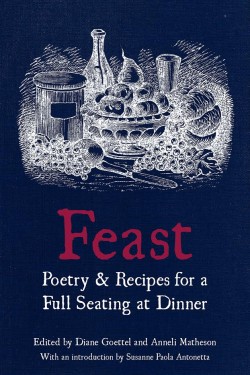
Finally Gray’s newest book is Steel Cut Oats arrived yesterday at my home. It’s a collection that includes both poems and recipes. I particularly drawn to the recipes and the idea of cooking preparation being part of a collection of poetry. Recently, Anneli Matheson and Diane Goetell edited Feast: Poetry and Recipes for a Full Seating at Dinner from Black Lawrence Press, one that is both poetry anthology and cookbook. Though I haven’t yet carried Feast or Steel Cut Oats into the kitchen to try to cook up what such poets and writers make, I have been feasting on the writing, turning the pages, considering how we might feed ourselves with such words.