The Chapbook Interview: Margaret Bashaar on Chapbook Publishing with Hyacinth Girl Press

How do you define “chapbook”?

For the purposes of Hyacinth Girl Press a chapbook is a cohesive collection of up to 30 pages of poetry, ribbon bound. That’s it.
You released your first chapbook from Hyacinth Girl Press in February 2011 and you write on HGP’s about page that you consider yourself a “feminist press” and are interested in “topics such as radical spiritual experiences, creation/interpretation of myth through a feminist lens, and science. We think outerspace, in particular, is pretty darn cool.” I think starting a micro-feminist is pretty darn cool, given the VIDA count, the general statistics about women authors being published, and the small number of other chapbook presses that publish women exclusively—Dancing Girl Press and you, come immediately to mind. What made you decide to start Hyacinth Girl Press?

I love publishing. I love bringing poetry that is not mine into the world. Honestly, I can’t recall if the VIDA count came out before or after I conceptualized HGP, but it did have an influence on me. Look, I love men. Some of my favorite people on this planet are men. I’m married to one. I am raising a tiny one. Two of my very best friends in all the universe are men. This doesn’t mean that they are not disproportionately represented in the poetry world. I don’t publish exclusively women by policy, but I will admit I am drawn to women’s poetry more so than to men’s poetry. Perhaps it is a sense of shared experience, perhaps it is a bias that I’m carrying with me, or perhaps it is that the female voice resonates with me more. I will admit that to date I have only accepted one chapbook by a male poet, and it’s actually a collaborative chapbook with a female poet.

I guess when I decided to start Hyacinth Girl Press I saw a bit of what I liked being published here, a bit there, but there was no press that I felt truly captured the kind of poetry I loved and at the same time embraced the beauty of the chapbook as an art object in the way I am striving to with Hyacinth Girl Press. I deeply respect Kristy Bowen and her work with Dancing Girl Press. I own any number of the titles she has published and I absolutely love the work that she does. At the same time I feel like she and I, while we do have some author cross-over, have different tastes and different styles, both as editors and as artists/book-makers.

Other presses I have huge, huge respect for artistically, editorially, and otherwise are Blood Pudding Press, Greying Ghost Press, Bateau Press, and Flying Guillotine Press. Every one of them has inspired me in some way and I owe a lot to the editors of each.

You say in an interview on Menacing Hedge “In many spiritual traditions, to know a thing’s name is to have understanding of and power over that thing. There is a certain claim of recognition that comes with naming something or someone…As a poet I do see naming as something that is very powerful, but also potentially limiting.” Can you talk about the origin and inspiration behind the name of Hyacinth Girl Press?

The first poem I read that made me say “That. I want to do that,” was T.S. Eliot’s The Waste Land, which I read in class on the sly in 9th grade while everyone else was reading a sonnet or something. I mean, I’d read and written poetry before, but this was the moment when I realized I wanted to be a poet. The Hyacinth Girl is a character in The Waste Land:

“You gave me hyacinths first a year ago;
They called me the hyacinth girl.”
—Yet when we came back, late, from the Hyacinth garden,
Your arms full, and your hair wet, I could not
Speak, and my eyes failed, I was neither
Living nor dead, and I knew nothing,
Looking into the heart of light, the silence

The hyacinth girl seemed to me to be this beautiful, youthful, ephemeral character – but not referenced again – she fades into the rest of the poem. These lines stayed with me, though, and I was left wondering who she was. Then, as I began reading more about feminist poetry (in particular reading Alicia Ostriker’s Writing Like a Woman) and then a few years later came to the decision to start my own press, I realized that I could, in a way, tell the rest of the story of this hyacinth girl, by giving that name to my press. Any one of the women I publish could be the hyacinth girl – beautiful, full of intelligence and life, full of something more than that brief moment of charming the speaker in Eliot’s poem.

I actually have a tattoo of a hyacinth on my thigh because of this press. Apparently I’m pretty serious.
In that same interview, you also say, “I was very interested in poetry as a shamanistic practice, the poem as invocation or spell.” Besides in your own poetry, does this manifest in the work HGP publishes?

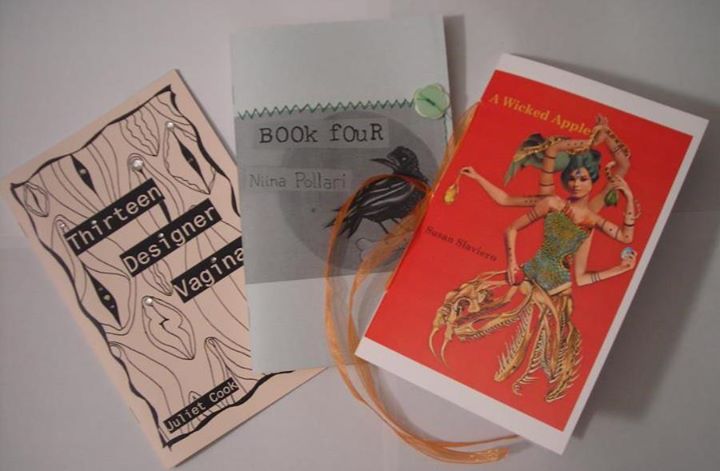
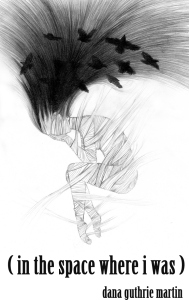
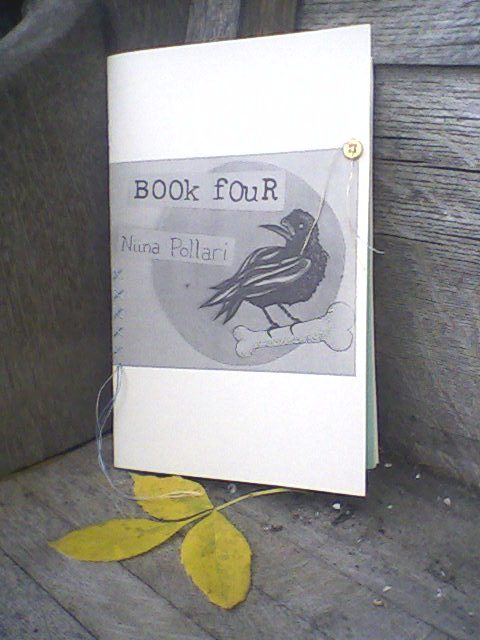
I try not to push my own ideas of what a poem is on anyone else’s poetry. However, Crystal J Hoffman’s chapbook Sulfur Water has definite hints of poem as spell throughout, and I would say that Dana Guthrie Martin’s In the Space Where I Was certainly has a chant-like quality to it. Susan Slaviero’s work is full of echoes of the esoteric, with poems about tarot and fairy tales. Niina Pollari’s Book Four also leaves me feeling as though I have been transformed in some way that is beyond my immediate understanding, and isn’t that what a spell does in the end?
In your Dutrope interview last year on the ideal submission, you write “Make me need your poetry. In THAT way” and that other additional evaluations include asking yourself “Would I give my last cupcake to this manuscript?” Many poets and readers know the head-over-heals feeling of falling in love with a chapbook of poetry. Have you given any thought to what makes that happen for you “in THAT way”?

I love reading poems aloud – if your poem reads aloud well, that certainly helps. I also seem to appreciate a certain amount of yearning in poetry, I think. Yeah, that’s not particularly helpful. I know. Voice is important, too. A strong voice, fresh imagery, and the absolute need to get to know your speaker. I also tend to like poetry that goes beyond the familiar world, poetry that challenges typical associations. I feel like I am doing an absolutely terrible job at answering this question.
Can you describe a few more of your recent titles and what made you fall in love with them?

The first chapbook I published in 2012 was Susan Yount’s Catastrophe Theory. I read, I think, the very first poem in the chapbook and was so incredibly overwhelmed that I ran to Facebook immediately (like you do) and posted a cryptic update about the incredibility of what I was reading. What made me feel like that about Susan’s work is the amazingly gutsy voice she has. Susan herself is a truly amazing and strong woman and that absolutely comes across in her work. Susan holds nothing back, but at the same time is so incredibly careful with her craft, and I really think that’s a balance that not many poets are able to hit.

Dana Guthrie Martin’s In the Space Where I Was is one of those manuscripts that I read the whole way through the very first time I sat down with it. The experience of reading her chapbook left me feeling like I had crawled inside Dana’s subconscious, fallen asleep, and had very vivid dreams if that makes any sense at all. It probably doesn’t. Just read the chapbook.
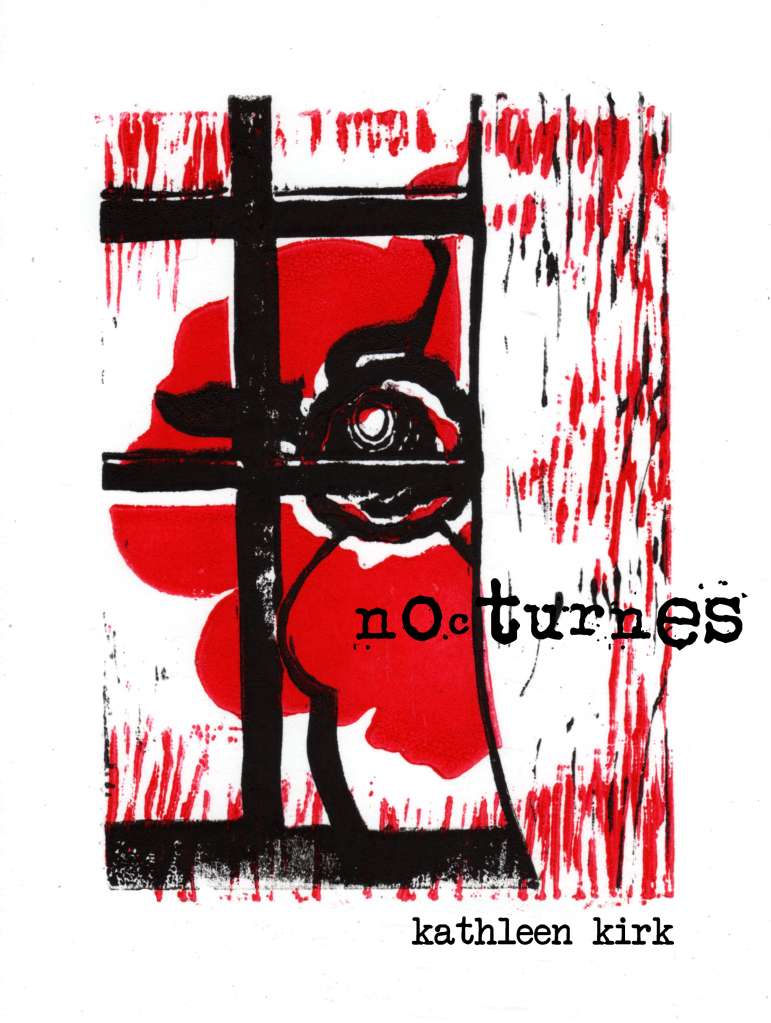
You note that you’re trying to keep your chapbooks physical. I love the physicality of well-made chapbooks. They can be an art form in themselves. Can you tell me a little about HGP’s production process? How do you turn an electronic submission into a real book?

Oh! This is where I get to brag about how incredibly amazing Sarah Reck is! Okay, so I can’t do layout for, um, anything. I mean, I could put something together in Publisher, but it would be passable, not beautiful. Sarah Reck, who is a dear dear friend I’ve known since we were in the second grade, volunteered to be my layout editor for HGP when I first announced I was going to publish chapbooks. Sarah is nothing short of a Godsend.

I send the manuscript to Sarah, Sarah does some sort of magic that I don’t completely understand, and sends me back a pdf of the manuscript. I send the pdf to the poet, and we go through as many corrections and proofs as we need to for the poet, Sarah, and me to all be happy. Then I print the manuscript on my industrial printer. I outsource the printing of the covers for the time being, but my husband and I are talking about purchasing a nice color printer soon, so hopefully in the next 6 months I will be doing all of the printing myself. Then I spend hours folding all the chapbooks and binding them with ribbons and stamping them.
Have you ever had to pass on a submission that you loved because what was submitted wouldn’t “work” as a chapbook or it was beyond HGP’s production capabilities?

I get submissions that don’t follow my guidelines sometimes (usually the length restriction), but as soon as I realize my guidelines aren’t being followed I stop reading and reject the manuscript, citing the lack of guideline-following. I’m actually trying to expand what HGP does creatively – Crystal J Hoffman’s chapbook is going to have a color page in the interior as well as a number of translations, including one in Arabic script, and another one of 2012’s chapbooks, Lisa Cicarello’s Sometimes there are travails is also probably going to have some interesting and different design elements. I enjoy a challenge. Hopefully Sarah does, too. So, no – I’ve never rejected a manuscript simply because I felt like it would be difficult to put together physically.


Since you started HGP, has there been anything new in the publishing industry that has been destructive to the art of chapbook presses? Helpful to the art to chapbook presses?

I feel like what I do is so far outside of big publishing that it really is not terribly effected by larger companies. Amazon and all the issues therein don’t affect me. Ebooks aren’t of concern to me right now. Being tiny can be wonderful.

I do think, though, that more and more people are looking to smaller presses as potential publishers for their work because of the problems they witness in big publishing. So it’s possible I’ve gotten more submissions and/or purchases because of what is perceived by some as the beginning of the end for large company publishing. Now, I have a good friend who works for one of the big five and could talk about that idea in a lot more detail and more accurately, so I’m not going to run my mouth and ultimately end up sticking my foot in.
Small presses tend to have small budgets. How do you manage HGP’s fiscal income each year? Do you dream that one day you’ll be able to give up your day job and do HGP fulltime?

I put my own money into HGP to start. Now the chapbooks pretty much cover themselves. I don’t think I could ever make a living wage off of HGP, but that doesn’t really bother me. At the size I’m at right now, I’m able to do the editing and reading and promoting on my own with huge help from my layout and design editor, Sarah Reck. I like it that way. If the press ever starts to become too big for me to handle with help from Sarah, I’ll probably scale back rather than add staff.
Do you have advice for a feminist chapbook press start-up?

Love what you are doing. Don’t ever accept a chapbook you don’t love. If love is not involved, just don’t do it. Love love love.


You’ve had two chapbooks published, Letters From Room 27 of the Grand Midway Hotel (Blood Pudding Press, 2011) and Barefoot and Listening (Tilt Press, 2009). Can you tell me a little about each and where they might be found

Barefoot and Listening is currently out of print – Tilt is defunct, sadly. I have three copies in my possession if you’re desperate to read, and Caliban’s in Pittsburgh has a couple of copies. Letters From Room 27 of the Grand Midway Hotel is in print, and it’s the one I would want people to read, anyway. I wrote it over the span of about 5 years and it’s about a real hotel located in Windber, Pennsylvania. The Midway is now a private residence owned by my dear friend, Blair Murphy, but he holds arts events there from time to time, and there is a group of artists, which I am a part of, who all work and create there together. My chapbook chronicles 4 characters who at once live at the hotel and exist in these sort of parallel imaginary lives as figures from the Romantic era. You can get it here.

What current projects are you working on?

I’m in the editing phase of a chapbook based on The Ladder of Divine Ascent that I co-wrote with Lauren Eggert-Crowe. Lauren and I “met” because she submitted her chapbook, The Exhibit to HGP which I will be publishing later this year. We didn’t meet in person, though, until well after we had drafted our chapbook. I’m also working on what will probably end up being a chapbook-length collection with Kelly Boyker about a character we developed together. As for writing all on my own, I’m working on expanding the Midway poems and slowly slowly on a series of poems on saints from multiple traditions. I’m also working on getting 6 more chapbooks out into the world in the next 6 months and picking out the final line-up for HGP’s third year.

Number of chapbooks you own: Over 100

Number of chapbooks you’ve read: Over 125 – I’ll admit that I don’t tend to read very many electronic chapbooks (I’m trying to get over this bias – I swear!), but I DO try to purchase ever single chapbook I’m interested in reading, which is why I own over 100 chapbooks.

Number of chapbooks you’ve published: 7 – though it might be 8 by the time this interview is posted.

Ways you promote other poets: I run readings and bring my poets into town for those, I try to table at the AWP conference whenever I can afford to, I talk about them and link to them on the internet whenever I get the chance, and, you know, I publish their chapbooks.

Where you spend your poetry earnings: More chapbooks!

Favorite flavors of cupcake: There’s a lovely little cupcake shop in Pittsburgh called Dozen that makes a cosmopolitan cupcake and good god it’s the best cupcake flavor I’ve ever had. I also like vanilla cupcakes with vanilla frosting. Vanilla is so underrated.

Inspirations and influences: Maria Sabina, Yusef Komunyakaa, my dad, Anne Sexton, Dadaism, Dr. Michael Dennison, typewriters, haunted spaces, documentaries on theoretical physics, lives of the saints/bodhisattvas, the Curiosity Mars Rover

Residence: Pittsburgh, PA and sometimes a haunted hotel in Windber, PA

Job and education: I have a BA in Psychology with a minor in Creative Writing. I work as an account recovery analyst for a company called CDR Associates. Yup.

Bio: Margaret Bashaar’s second chapbook, Letters From Room 27 of the Grand Midway Hotel, was published by Blood Pudding Press in 2011. Her poetry can also be found in journals such as Caketrain, elimae, RHINO, New South, Menacing Hedge, and elsewhere. She co-hosted and worked on The TypewriterGirls Poetry Cabaret with Crystal J Hoffman and currently edits Hyacinth Girl Press and occasionally runs a poetry reading here and there. She lives in Pittsburgh, PA with her husband, her son, and far too many typewriters, which she firmly believes are haunted.
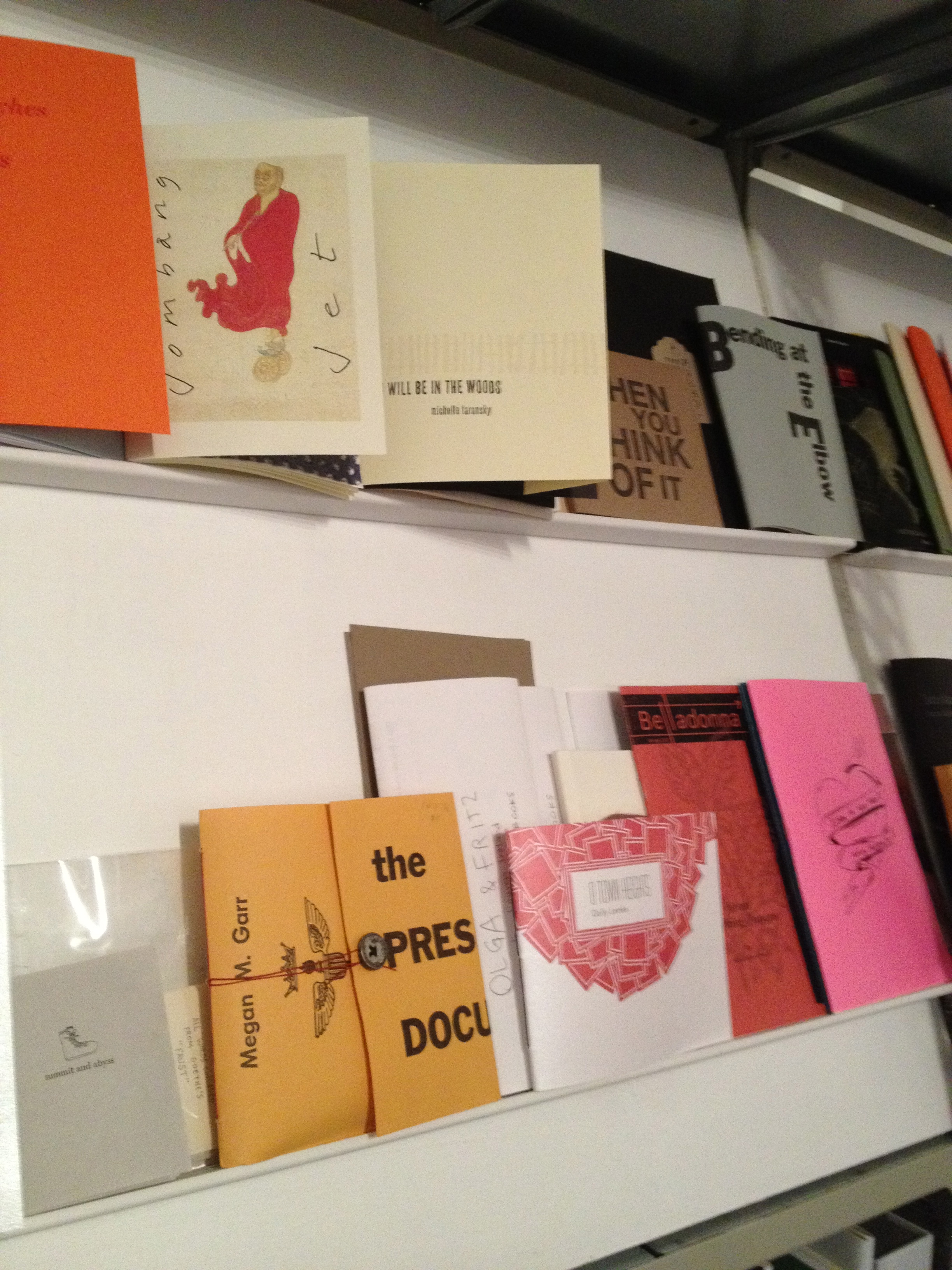
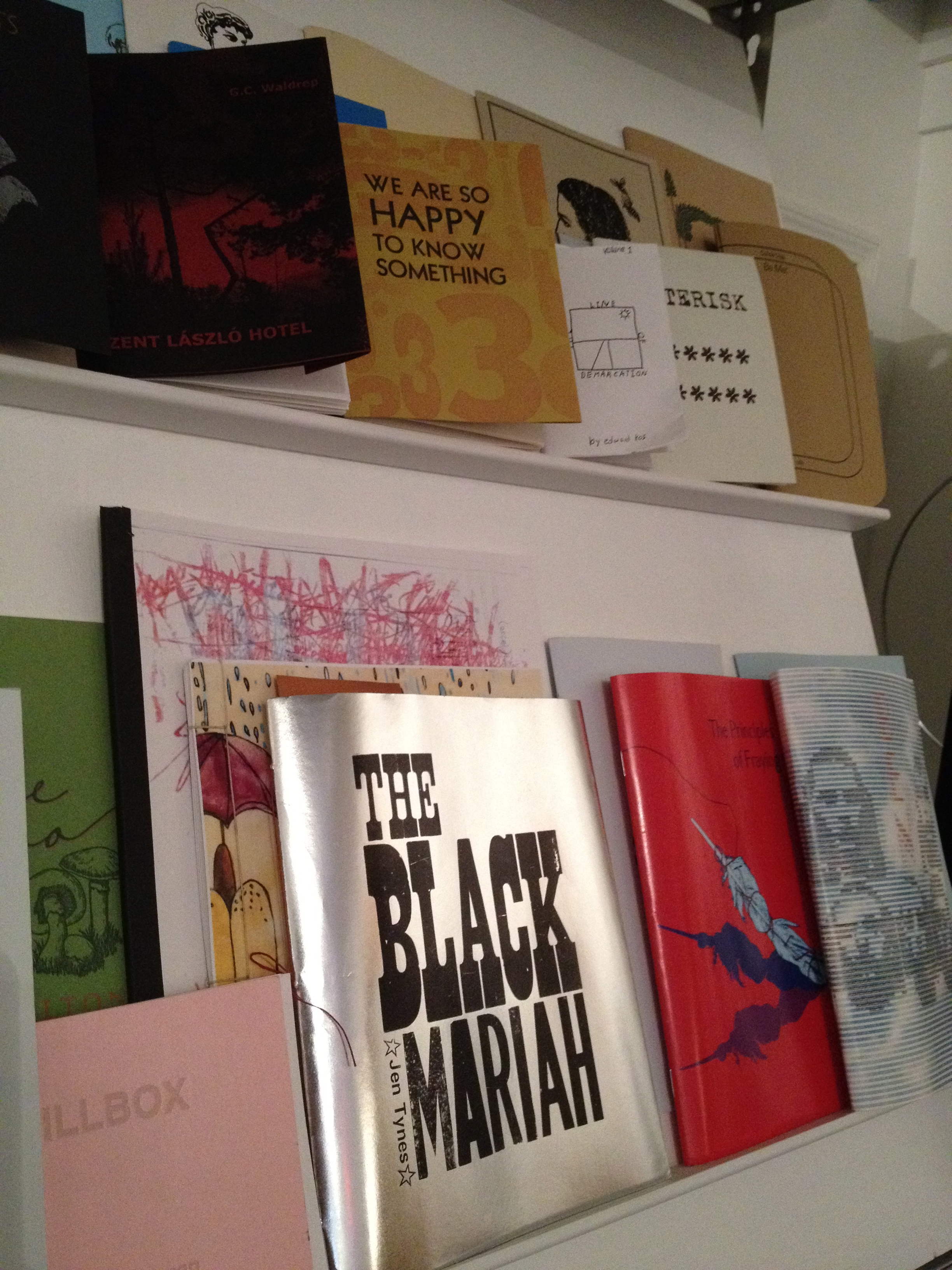


blurbs for Unclose the Door, a forthcoming chapbook on Matilda Fletcher

Yay! I’ve just received blurbs from Naomi Shihab Nye, Lisa Lewis, and Susana H. Case for my forthcoming chapbook UNCLOSE THE DOOR from Gold Quoin Press about Matilda Fletcher, the nineteenth century suffragist, lecturer, and poet, my great-great-great-grandmother, and the subject of my dissertation.

When Naomi was the visiting writer at the University of Nebraska-Lincoln in the spring 2009 I took her master poetry/nonfiction workshop. I’d been enamored with her writing since I’d read her poetry in various literary journals and attended her reading at Split this Rock in 2008. Here’s a video someone took of the last poem she read from Honeybee. (FYI: the footage is shaking, but the sound is perfect. It’s a little easier to just listen to the recording).

I really enjoyed Naomi’s class and the one-on-one tutorial with her over an my essay. The poems in UNCLOSE THE DOOR come from the series on Matilda Fletcher I had begun that semester and a series that would become my dissertation, many of them I brought to that workshop. Naomi offered encouragement to continue working on the series. I loved researching Matilda, a strong, powerful, inspiring woman in my family. When Naomi wasn’t being a topnotch teacher, editor, fellow poet, and peer, she gave an amazing reading at the Great Plains Art Museum that connected with the audience. I think of her each time I step up to the microphone.

What a fascinating, eloquent way to open history, to enter rooms of rich voices and care which precede our own time - Laura Madeline Wiseman skillfully honors the stories of her ancestors and all our lives by inviting us to enter with her. ~Naomi Shihab Nye, author of Honeybee and You and Yours

Thanks, Naomi!

I’m a big fan of Lisa Lewis’ work, the style of her poems, the perspective she takes on in Unbeliever, Silent Treatment, and her chapbook Story Box. Her feisty, smart poetry continuously inspires my own work.

Because, as history has shown, they are so often erased, preserving the stories of the foremothers may be the ultimate feminist act. Laura Madeline Wiseman’s Unclose the Door performs artistic homage to a character from the poet’s own family tree—suffragist, lecturer, and inventor Matilda Fletcher—by giving her voice in this collection. Following the tough, thoughtful Matilda through intimacy, loss, and activism, Wiseman packs these poems with historical detail and insights into Fletcher’s personal interactions—and adventures—in elegant, compelling poetic language.
~Lisa Lewis, author of Vivisect and Unbeliever

Thanks, Lisa!

I started reading Susana’s poetry in literary journals and then in her lovely chapbooks The Cost of Heat and The Manual of Practice Sexual Advice. Desire, heat, and connection permeate her work, themes that connect with UNCLOSE THE DOOR and Matilda’s life long loves. I was so tickled when she said “yes!” to my query about interviewing her for my blog series and feature on chapbooks. When I sent her the questions for the interview, she was in Budapest (it was the summer) and planned to finish the interview on her new ipad, which she hadn’t done before, to compose the interview. I couldn’t help but imagine some distant foreign city where language melts around you and you try to do your own work, sipping rich small cups of coffee.

Linked through her family history to Matilda Fletcher—suffragist, writer, lecturer, inventor (of an improved portable trunk), and the subject of the well-crafted work in Unclose the Door—Laura Madeline Wiseman’s chapbook should interest all readers of poetry, not only those interested in historical poems. Politically aware, Wiseman’s writing in poems like “Judge Hilton and the Women’s Hotel: Matilda Lectures” illustrates the tribulations of an unescorted woman’s negotiation of public space in that period. Wiseman uses letters and other narrative forms within her chapbook evoke a linear timeline in 19th century America and a vivid personality on the page. Images of Fletcher—her travels with Susan B. Anthony, the contexts of her lectures, her reaction to the proposal of her second husband—leap from the poems.
- Susana H. Case, author of The Cost of Heat and The Scottish Café

Thanks, Susana! And yay! I talked to the press a little earlier in the week and the editor is looking at mid-October to begin production of UNCLOSE THE DOOR. How exciting!

social media

Poets, essayists, and novelists on Social Media (this is a list generated by my students of writers they admire and follow on social media for an essay assignment in my composition class)

Dan Abnett: Twitter

Sherman Alexie: Twitter

Mitch Albom: Twitter

Laurie Halse Anderson: Goodreads

Jami Attenberg: Tumbler

Steve Berry: Goodreads

Kate Brian: Twitter,

David Brin: Google+

Meg Cabot: Facebook, Twitter

Joy Castro: Facebook, Twitter

Michael Chabon: Facebook

Stephen Colbert: Twitter,

Malorie Blackman: Twitter

Ellen DeGeneres: Twitter,

Sally Deskins: Tumbler

Sarah Dessen: Twitter,

Janet Evanovich: Facebook

Ryan Grim: Twitter

John Grisham: Facebook, Goodreads

Chelsea Handler: Twitter,

Nick Hornby: Facebook

E. L. James: Twitter, Facebook, Goodreads

Mat Johnson: Twitter

Tayari Jones: Twitter

Amy King: Goodreads (coordinates the group !Poetry!)

DJ MacHale: Facebook

Rachel Maddow: Twitter

Gabriel Garcia Marquez: Facebook

Cormac McCarthy: Facebook,

Robert Morris: Twitter

Dave Pelzer: Twitter

Jodi Picoult: Twitter, Facebook

Christopher Paolini: Twitter

Rick Riordan: Twitter

Philip Roth: Facebook

Nicholas Sparks: Twitter, Facebook, Google+

Cheryl Strayed: Twitter,

Ned Vizzini: Twitter

Scott Westerfeld: Twitter

Other social media sites

Linkedin, LibraryThing, Red Room, Gather, She Writes, Goodreads, Pottermore, Redlemona.de


Groups of writers, poets, and readers on Social Media

Facebook

Goodreads

The Chapbook Interview: Laura Goldstein on Prolific Chapbookists

How do you define “chapbook”?

I like starting with the explanation that it is abbreviated for “chapter book”, so it is like a floating chapter of a larger project. However, as a genre, they’ve really taken on a strong aesthetic and cultural identity of their own. As designed objects, there’s so much freedom that the publisher has with materials, colors, cover design, binding and size. Also, I think that poetry can be easier and even more appropriate to handle in smaller doses, so it’s great to have these shorter-format books of poetry out there. Lastly, concept-wise, if you consider this shorter project as a whole, it can become a little, focused, complete entity out there in the literary world, which I think can make a really strong statement.

Many of your poems are prose poems. How would you define the form of “prose poem”?

This has come up a lot lately. I never really endeavored to study or write “prose poems” as separate from “regular poems” and am a little thrown by this distinction. Some of my poems just don’t have line breaks in them and, instead, rely on the sentence rather than the line as one of the components of its structural meaning (along with “stanza” or shape). That right there could be the main different between poems and prose poems. Line break versus sentence. For me as a contemporary writer, this doesn’t seem like enough of a major difference to create a whole separate category that would remain a valuable distinction. For instance, poets who use a lot of imagery are no longer called “imagists”… I think that line break is just one of many poetic choices that a writer can make. Or not.

For you, what makes the project of a chapbook different than the project of a book?

I don’t start off with the idea that a certain group of poems is going to be a chapbook. Most of my poems are longer pieces, and a few (Ice in Intervals, Facts of Light and Inventory) have been turned into chapbooks. Let Her was a bit different. I looked for poems that all conformed, even if somewhat loosely, to themes surrounding gender specifically for dancing girl because of their mission statement. I had been writing about gender for a few years, so it was a great way to look back on that period and then collect those pieces for a shorter, concise publication. So, the project of submitting work to be published as a chapbook can be based on grouping poems according to theme, or submitting a longer work that can be read as a cohesive whole, and makes sense as a bounded object.


Why do you think “books” are given more weight, in some circles, than chapbooks?

Well, it can be a lot harder to get a full-length collection selected and published because of the costs, press runs and process of selection of a larger press. There are various levels of status that are recognized in the poetry world, and perhaps these also coincide with the size of the readership that is made possible by having a full-length collection selected and published by an established press. I think that chapbooks are in a different category. I think that they often function more as art objects because of the smaller run and the freedom of design. However, status aside, I love the fact that people might pick up a chapbook and not have all of that weight attached to it when they encounter and read it. Hopefully it can be a lighter, fun and sincerely enjoyable experience to read the work.

You’re the author of four chapbooks. Can you tell me a little about each?

My first chapbook, Ice In Intervals, (no longer in print) has a zebra on the cover and asterisks in rainbow colors. This was a design choice made by the publisher, Michelle Detorie of Hex Presse, because of my use of asterisks to create boundaries between the individual sections and the rest of the page. Each section occupies a different space on the page, and the asterisks are meant to emphasize the white space because I was very interested in how the page might represent a unique “moment”in the brain and the stark contrast between an idea and then the white noise of total consciousness. The zebra is sort of a deceptive non-sequitur in the poem. I was so happy that Michelle wanted to put a zebra on the cover. The black and white animal contrasts well with the multi-colored punctuation.

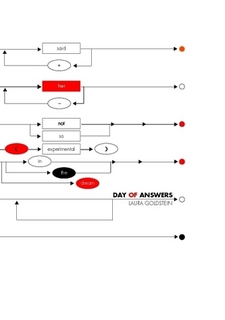
My second chapbook was a “micro-chapbook” (available) published by Drew Kunz of Tir Auz Pigeons. I loved the idea of a 3-page chapbook and submitted a strange little 3-page poem that I wrote. I enlisted my friend, poet Amira Hanafi, to design the cover. She’s really an amazing visual poet and makes these great designs with words. She made this kind of word map of one section of the poem. Since that piece (and I am in general) was influenced by Gertrude Stein, the parsing and mapping of the sentence was a great indication of the project within.

My third chapbook was Facts of Light, which was published by Edwin R. Perry who runs Plumberries Press. He makes absolutely gorgeous books, and every one is different. Facts of Light (no longer in print) is only ten pages long, so he had visual poet and designer Melissa Dunkelberger create these truly amazing images that consisted of pieces of an apple and geometric shapes that created an ongoing, shifting record of light and dark arrangements. I think that it creates a really interesting discussion with and commentary on the piece itself, which consists of individual lines of rotating themes throughout the book.

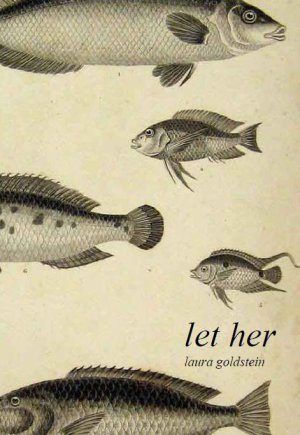
M fourth Chapbook is Let Her (available). Again, I was so thrilled to have Kristy Bowen of dancing girl press accept the work and then read it really carefully to make a decision about the cover. The poem Sisters is about my relationship with my sisters, especially when they were both going through their first pregnancies and my confusion about the boundaries between us, because we are so close, and the boundary between human beings when you are pregnant. I had a strange dream about a fish (it’s in the poem) and then the theme of fish and water and how water creates connections between things became really important in the poem. The poem became the centerpiece of the book. Kristy picked up on the idea of fish and the cover has all of these different fish swimming in different directions. I think that it says a lot about what is going on inside.

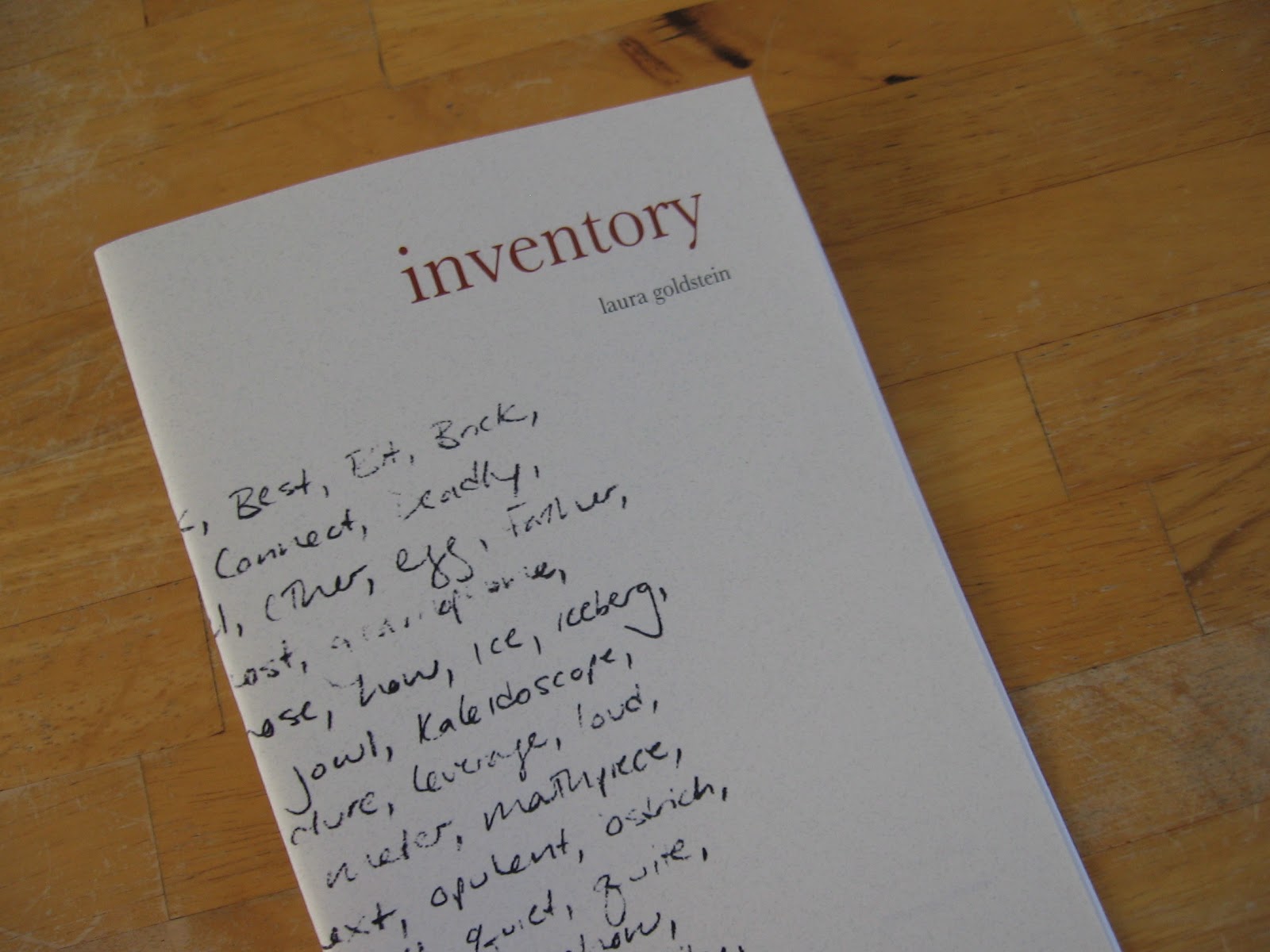
Ok, so I have FIVE chapbooks now- my chapbook Inventory (was available by subscription only) was just released by Sona Books, which is run by Jill Magi. That was a full-length project, clocking in at 26 pages, because it was initially inspired by the structure of the alphabet. Jill actually really helped me with the editing process of that poem and we worked really closely on the design. She asked me to write out the list of words that I had started with when first beginning the project about 7 years ago and printed it in my handwriting across the cover. For a much more detailed explanation about that project, please read my statement about it on her blog.

Some poets, myself included (e.g. Julia Cohen, J. Hope Stein, Grace Bauer, Kristy Bowen, Cati Porter, etc.) have several (three or more) chapbooks published before they have a book accepted. Some chapbook poets are so prolific! Given that you too are a prolific chapbook poet, what’s that about for you? What is it about your work that lends itself better to the chapbook form?

I think that the cohesive nature of my poems as longer projects definitely lends itself to the chapbook form in the literary/world. I sometimes worry that having several longer poems in a full-length collection might be a drawback when seeking publication, but I’m pretty confident that my particular structure and format will find a home.

The chapbook has become a distinct form in the literary world from the full-length collection. There is some crossover, like a chapbook really will represent a chapter of a later full-length book, but the longevity of the genre to this point has developed new constraints and possibilities for poets that make the requirements for each type of publication (chapbook and full-length) very different. Some poetry definitely lends itself better to the chapbook format, and I think some poets now specifically write towards producing chapbooks. For instance, with my work, the longer nature of most of my pieces (10-50 pages) make them prime material for a shorter format literary entity- they just match up really well.

I also think there’s a component of how publisher and poet find each other that works its way into the equation. Publishers, whether of full-length works or chapbooks, have different ideas of who their communities are and how they want the work they publish to reach them. Each poet may fit various publishers’ philosophies and format better than others, and some are perfectly suited for the sometimes quirkier and more artistic chapbook form.

What current projects are you working on?

I’m currently working on a full-length project (75 pages) called five, which was initially inspired by the structure of the Five Books of Moses. I’m very curious about the importance of this number as the books solidified into the canon of cultural and sacred texts. I have a theory that Moses himself is just a personification of the number five since his name in hebrew is very, very close to the hebrew word for five. So, structurally I am using the number five to direct the poems. Each poem is five pages long. Conceptually, I am interested in the period of time when Moses and the Hebrews are wandering the desert, between the past and the future, becoming a nation. I am curious about this fundamental notion that the identity of being a nation is still necessary to being organized for the best for people. What went along with establishing an identity as a nation was developing a hierarchical structure. At first, Moses, who was a very reluctant leader from the beginning, is just exhausting himself by addressing every concern that people bring to him during the day. At some point, his ex-father-in-law tells him that he needs to delegate. I think that’s an interesting moment. Family and tribal relationships are detaching to form a national structure. I also think that it is interesting that Moses is eventually not allowed to enter the promised land. He is a failed leader, and therefore another beautiful example of the paradoxes of being human that the Torah offers, perhaps the necessity of failure, a new kind of sacrifice. I’m interested in this notion of wandering and diaspora before hierarchy and settlement, and displacement rather than integration. I’m interested in the alternative power of associative thinking and constant flux. Every time I want to write a poem for this project, I choose a subject that I think might help to illustrate those ideas. However, I want the central piece of the poem to be a 25-page reading of the story of Moses in the desert with the Hebrews in association with the modern problems of our stalled hierarchical democracy.

Number of chapbooks you own: at least 50!

Number of chapbooks you’ve read: at least 50!

Ways you promote other poets: Buy their work, read it, comment on it in various places, curate for them as part of the Red Rover Series, which I co-curate with Jennifer Karmin

Where you spend your poetry earnings: snacks

Inspirations and influences: Ah! So many! From all sorts of contemporary conceptual poetry and art by famous people and friends, that is just constantly ongoing from reading more and going out to see more art that is happening in the city. I realized lately that the biggest influences on my writing style are Gertrude Stein, Harryette Mullen and Richard Brautigan. However, I am also extremely influenced by performance, installation work, and really good film. I am a big fan of the text/performance work of Caroline Bergvall as well as artists Mark Jeffery and Judd Morrissey, filmmakers Lars Von Trier and Charlie Kauffman, and video installation artists Yoni Goldstein and Meredith Zielke. Any work that considers and uses its own material conditions as part of the process and final result, not merely as a transparent vehicle for content. I really value experience in the moment and how it can change you in ways you don’t realize. I also attempt to create that kind of nebulous space on the page and by provoking the more uncanny effects of language. I write about Caroline Bergvall here, Mark and Judd’s work can be found here, I write about it here, and Yoni and Meredith’s work can be found here.

Residence: Chicago

Job and education: Full-time Instructor at Loyola University. MFA from School of the Art Institute of Chicago, MA from Temple University, BA from University of Pennsylvania

Bio: LAURA GOLDSTEIN’s poetry and essays can be found in American Letters and Commentary, kill author (August 2012), MAKE, jacket2, EAOGH, Requited, Little Red Leaves, and How2. Her chapbook Let Her was released from Dancing Girl Press earlier this year, and her newest chapbook, Inventory, was just released by Sona Books at the beginning of June. She currently co-curates the Red Rover reading series with Jennifer Karmin and teaches Writing and Literature at Loyola University.

three poetry readings in July

Last month, I had the opportunity to read locally thrice. I read in the War is Trauma event organized by Cat Dixon and Shawna Foster. It was a great and important event to honor our veterans and their stories! I was impressed by the turn out and the range of voices reading their work. It was such a treat to read with Brent Spencer, Fran Higgins, Greg Kosmicki, and many, many others. The reading was in conjunction with the War is Trauma exhibit in Alley Gallery at Hot Spots. I read from my chapbook GHOST GIRL that includes an ekprhasis poem responding to Tim O’Brien’s novel In the Lake of the Woods.

I also read a poem from my forthcoming collection UNCLOSE THE DOOR, a chapbook on the life of Matilda Fletcher, my great-great-great-grandmother who was a suffragist, lecturer, and poet. Her first husband and all of her brothers served in the Civil War.

A few days later, I also read with Cat Dixon at Poetry at the Moon.

We had a wonderful turnout with lots of great readers during the open mic afterwards. I read from my new chapbook SHE WHO LOVES HER FATHER

and my forthcoming chapbooks UNCLOSE THE DOOR

and HONEYCOMB OF DEAD SWEET BEES.

Finally, to launch the summer issue of The Lincoln Underground, a new literary magazine here in Lincoln, I read my poem in that issue and a few others from SHE WHO LOVES HER FATHER. It was a good turn out. I was happy to hear poets, a novelist, and song writers read/perform their work. The editor even read a few poems from contributors who couldn’t attend. It was such a nice event. I was so glad I could be a part of it!