How do you define “chapbook”?
I tend to consider a chapbook a short collection of poetry or prose by one author that follows, more than likely, one theme or idea or emotion. I’m relatively new to the chapbook scene, though I spent time in college and graduate school reading and working on lit magazines. I don’t know if there’s really a firm definition of either, but in my mind there’s a distinction between the two in that a lit mag pulls in both poetry and prose from multiple authors and therefore they don’t all necessarily fit together perfectly. A chapbook, on the other hand, is a collection of several pieces of one whole.
In Margaret Bashaar’s interview she describes the process of turning an electronic chapbook submission to a real chapbook that “Oh! This is where I get to brag about how incredibly amazing Sarah Reck is…I send the manuscript to Sarah, Sarah does some sort of magic that I don’t completely understand, and sends me back a pdf of the manuscript.” Can you talk a little bit about your process and the “sort of magic” that you do?
The first thing I do is read through the poems and to get a feel for the tone and the themes and the overall feeling I get from the poems as I’m reading them. It sounds strange but I often have a font or fonts in mind after a read-through, and I set the poems out as soon as I do. The manuscripts come to me formatted by the poet, and I take care not to lose that formatting, because I know that an indent, a space, or a single word might change the poet’s intent. I’m a pretty visual person, which I think works well when it comes to the spacing and design of a poem on the page. Once I’ve got the entire book laid out, I get it into .pdf form and send it off to Margaret, and then we work together with the poet to make sure we’re all on the same page and everything looks fantastic.
Can you tell me about a few of the chapbooks you’ve designed for Hyacinth Girl Press?
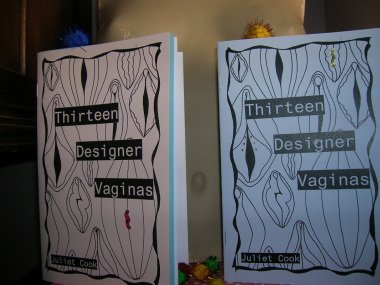
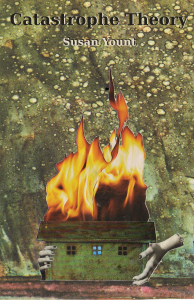
One thing I think Margaret does so well with acquiring collections for HGP is that she finds poets and collections that are so varied and unique. We started with Juliet Cook’s Thirteen Designer Vaginas, and that was my first go at laying out a chapbook. It’s interesting because the poems don’t have individual titles, and each fits like blocks on the pages. It’s a fun design, almost utilitarian, which I think fits the feel of the collection. Niina Pollari’s Book Four is another without titles, and in this case it gave me the opportunity to play with negative space and open up the poetry right there on the page. And Susan Yount’s Catastrophe Theory is a collection of poems, none of which are formatted or designed the same way. It was challenging to produce, but I like the way it translated from my computer screen to the printed page. Visually, it’s really fun and different.
What has been your favorite chapbook to design and why?
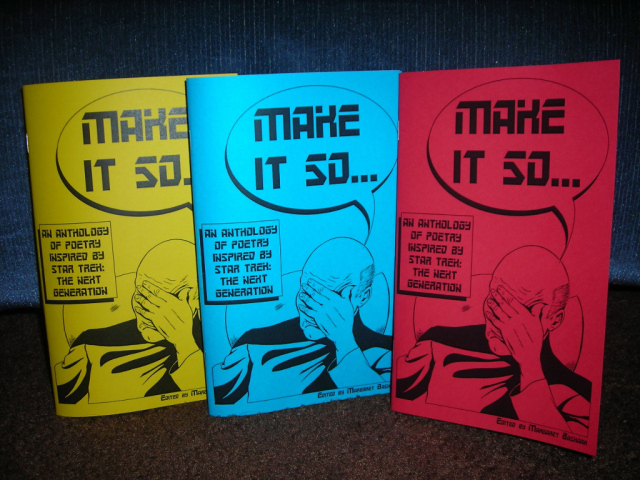
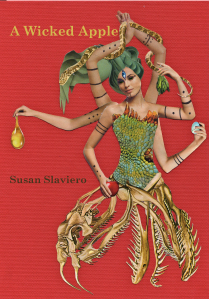
Poetically, I love Susan Slaviero’s A Wicked Apple. It’s a wonderful collection of fantastical pieces, very fairy-tale in inspiration. It’s beautiful. Stylistically, Make It So… which is an anthology of poetry inspired by “Star Trek: The Next Generation.” I had the opportunity to play a lot more with font and internal design elements, giving it a feel that really speaks to both my inner geek and to Star Trek.
What current chapbook are you working on?
I just put the finishing touches on J. Hope Stein’s [Mary]:, which will be out soon from Hyacinth Girl Press. I liked designing it because it’s a combination of poetry, prose, and the format of a screenplay or dialogue. And I’ll get started shortly on Deena November’s Dick Wad.
Since you started doing the design and layout for HGP, has there been anything new in the publishing industry that has been destructive to the art of chapbook presses? Helpful to the art to chapbook presses?
I don’t think anything has been destructive because I do think there will always be a market for handmade, hand-designed books by talented artists. There’s something comforting and exciting about knowing how a few, real people all touched a chapbook as it comes to life.
How does your day job of working as a web publicist for a major publishing house influence your work with HGP, a small feminist press?
In my day job, books come to me already packaged and complete, and I get to market and promote them. What I love about working with Margaret at HGP is that it’s a completely different period in the life of the book. I like the hands-on experience of working with a small press. I mean, I love books and the written word and supporting fellow writers more than anything, and that fits into both my job and my work at HGP. Being able to produce a beautiful piece of art for and with someone else is a wonderful feeling.
You’ve been writing young adult novels, correct? What current writing projects are you working on?
My most recent novel, Birthright, just got a rewritten and extended ending. It’s a steampunk adventure set in an alternate NYC. While I’m looking for representation for it and my other novels, I’ve started a new project that explores what faith and religion would look and feel like in an America that forbids and has essentially made it illegal to practice any kind of religion.
Number of chapbooks you own: About 10, but full disclosure, the majority of them are from Hyacinth Girl Press. I’m currently working on building my collection and seeing what other small presses are doing. I also have about a dozen several lit mags tucked away from college.
Number of chapbooks you’ve designed: 9
Favorite flavors of cupcake: Red velvet or pink lemonade.
Inspirations and influences: Edith Wharton, Marjane Satrapi, Stephen Dunn, JK Rowling, William Shakespeare, John Donne, Michael Chabon.
Residence: New York City
Job and education: I manage social media and online promotion for three inspirational and religious imprints at a major publishing house. I hold an MFA in Writing and an MA in English from Chapman University, and I did my undergrad work at Lycoming College.
Bio: Sarah Reck’s short stories and poetry have appeared in The Tributary, Elephant Tree, and Make It So: Poetry Inspired by Star Trek The Next Generation chapbook. She is co-founder and managing editor of Litterbox Magazine, now on hiatus. While she calls Pittsburgh her home, she currently lives in New York City with her cat, Lola. You can find her online on Twitter, Pinterest, and at SarahReck.com.