Broadsides - The Disappearing

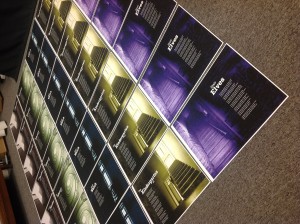
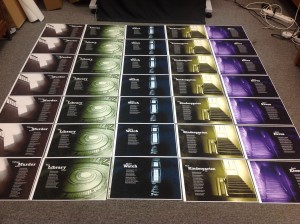
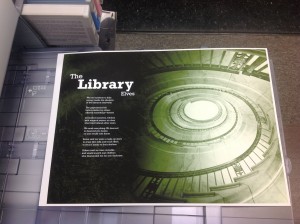
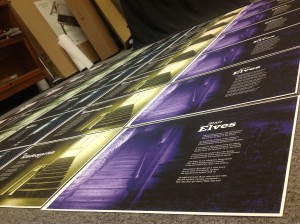
One of the projects I’ve been working on during my residency at the Prairie Center of the Arts is a new series of broadsides that combine poetry and photographs by Adam Wagler, digital artist extraordinaire. When I arrived mid-May, the first thing I did was begin writing and revising poetry that might work together to form a shorter series. One thing that fascinates me about Adam’s work is his focus on perspective and disappearing points.

Many of his photographs offered unique vantages on stairwells, architecture, and the natural landscape from around the world.

Particularly, I loved his focus on stairs. As I began going through my own poetry, I noticed I too had many, many poems where stairways were an element of the poem.

Something about the in between space of stairs, of a path that leads up and down, a crossroads within the space of buildings interests me. There were ghosts on the stairs, elves in the stairwells, murders happening only floors apart, and children climbing up and down, playing, unable to dismiss a set of risers as a functional passage, but saw them rather as a place to climb, imagine, and explore. So from about fifty poems, I culled five: “The Library Elf,” “Village Murder House,” “The Kindergarten Elf,” “Night Watch,” and “Stair Elves.”

The artist and I went back and forth over the next three weeks selecting photos, discarding photos, discussing layout and design, adding brushes, taking away or softening brushes, sending the proofs to colleagues and friends to check on typos and design, and finally, Thursday we printed a test print.

Once we had a scaled down version of all five images, we made further final touches and revisions and finalized the digital version of the art.

Friday, we printed the limited edition press run. Yay!

Once we were finished printing, we signed and dated them -The Disappearing. I’ve set up a page with more details on the project, but wanted to offer a little description of the cool things that can be done at a residency and that can happen between artists and poets. Collaborated projects are so fun.

The Chapbook Interview: J. Hope Stein on Invention

How did your chapbook, [Talking Doll], begin?

[Talking Doll] is an exploration of one of the characters from my full-length manuscript The Inventor’s Last Breath, which is about an inventor, loosely based on Thomas Edison. One of Thomas Edison’s inventions was the talking doll – an evolution of the phonograph. I took advice from one of my mentors, Carol Frost, who read a few Talking Doll poems I had written and suggested I write more of them and imagine her more completely. For my process, chapbooks are a playground for this sort of creative exploration.


How long did you spend writing it? How many versions did it go through before you reached the final? How did your peers and readers shape the revision process?

When this was accepted I think I had been working on the Inventor project for a little less than 3 years – but there are several working parts to the full book manuscript. The poems that made it into [Talking Doll] were written in 3 or 4 spurts. My peers, readers and mentors, know much more about poetry than I do- I learn so much from their feedback.


How much time did you spend to find a home for it?

Dancing Girl Press was the first place I sent it- I was very lucky. But don’t worry, I have a lovely history of rejection.

Tell me more about the poems and themes in [Talking Doll]. I’m enamored with the idea of inventor and inventions. There’s something so hopeful and haunting in the idea of creating something never to be seen before. I love how this comes out in your poems like “The Inventor’s Last Breath” and “Invention of the Talking Doll.” I’m equally thrilled by the sass in the second section of [Talking Doll]. How did you go about putting such a sequence together?

The second section — Half of it was the first thing I wrote over 3 years ago when I started this project. It was very influenced by an article I read in an archived newspaper about “Light’s Golden Jubilee” – the celebration in honor of the 50th anniversary of the light bulb. It was a huge party thrown by Henry Ford in 1929 in honor of Thomas Edison – all the luminaries of the day were there- Edison, Ford, John D. Rockefeller, Orville Wright, J. P Morgan, Charles Schwab, Herbert Hoover, Will Rogers, etc. It seemed like an interesting intersection of American history, because 4 days later, the stock market crashed leading into the Great Depression.

At the celebration, there was a “let there be light” type of re-enactment of Edison inventing the light bulb. The newspapers wrote about Edison as if he were a magician or a religious figure and that made a lot of sense to me. So, the Talking Doll attempts to tell the story of her maker, who invented the light bulb, phonograph, moving image, electric chair, etc. And, linguistically she borrows from Genesis and Whitman (a contemporary of Edison’s) to do it.

The “sassier” half, I wrote much later, after I randomly found myself at the 90th birthday party of an American film icon. The décor of the room was early 1900’s elegance and many of the luminaries of our day were in the room and it was at a time when the economy was crashing. There was a man I was sitting next to at dinner and I was telling him that I was feeling claustrophobic and that the room reminded me of the Titanic and that I could feel it sinking. He responded – I was IN The Titanic. Turns out he was an actor with a pretty prominent role in the film The Titanic.

The essence of the evening reminded me of what I was responding to in the article about the “Light’s Golden Jubilee” celebration that I read about in the 1929 newspaper. I went home and wrote that night and what came out was a 1929-styled orgy involving Edison, Hoover, Rockefeller, J. P Morgan, Charles Schwab, Madame Curie and Will Rogers.

What about the publication of the individual poems prior to the acceptance from Dancing Girl Press? Some of these poems first appeared in print. Do you seek to publish your poems in print, online or a mix? Is there a balance you prefer of published and unpublished poems in a collection?

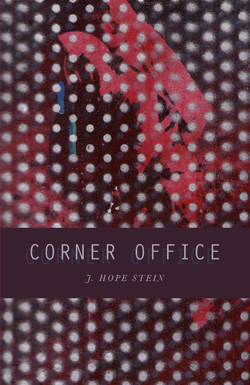
I haven’t published too many individual poems. I keep meaning to do that. Invention of the Talking Doll was published in Ping Pong and The Inventor’s Last Breath was published in Poetry International. Both are publications I love. It’s a good question- online vs print. For me it depends on the piece. For instance, I published my chapbook Corner Office with H_ng_m_n as a digital chapbook because I think the content lends itself to digital.

Tell me about that cover art, design and layout. I love Sara Lefsyk’s cover artwork. How involved were you with the selection of cover and the interior layout and design?

I cannot say enough about Sara Lefsyk. She is a rare artistic soul and I am very thankful she exists. Look up Sara’s poems!

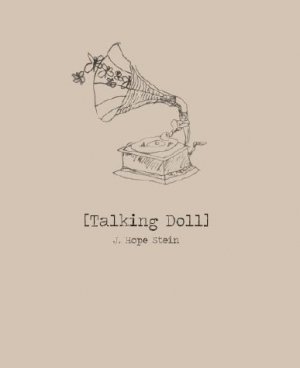
We’ve been trading work over the last 3 years or so and she sent me a handmade postcard in the mail with a line from my manuscript – “There are the things you can see and the things you can’t” with the illustration of the phonograph which appears on the cover with musical notes floating from the horn. I just took an IPhone picture of the postcard and sent it to Kristy Bowen at Dancing Girl Press and she did everything else, including layout, choice of paper, etc. I was really happy with the choices she made.


What was the time between acceptance of your chapbook and publication date? How much editing of the poems and manuscript did you do during this time? When did you know, really know [Talking Doll] was done and ready for the world?

It was accepted in the fall of 2011 and published in February or March of 2012. I didn’t edit too much in that time.


Once you’d sent the final version of [Talking Doll] to Dancing Girl Press, how long did you wait until you had the chapbook in your hands? What did you do during this time?

It was in my hands a month or so after my final draft. In that time, I focused on new work.


It seems there might be a lingering sense among some poets, writers, and editors: poets must win prizes. Even the May/June 2012 Poets & Writers discuss the necessity of contests to bolster memberships for journals, covering part of running and managing a contest, and creating opportunities for writers of poetry and short story collections a venue for publishing their books and chapbook. Were you ever concerned with this when considering where to submit [Talking Doll]? What advice would you offer other poets considering contests and open reading periods for their chapbooks?

Regarding where to send things and why – I think that is a very individual thing. For me personally, as I mentioned, chapbooks are a playground to try things. I feel very lucky to have publishers who support creative exploration – H_ngm_n, Dancing Girl Press and Hyacinth Girl Press. I am thankful for what they do and they publish wonderful poets.

What advice would you give a poet about to promote their chapbook? What advice would you offer to someone in giving good readings?

The thing that makes me write the way I do is the same thing that makes me uncomfortable in front of people. But recently I found something powerful about reading in public that I can’t shake. My goal in reading in public is to try to forget the audience and be alone with what I wrote in front of people. There’s something unexplainable that I gain when I am able to do this. It is so rare that I am able to do it but it’s enough to keep me seeking. This is not advice, obviously, everyone has a different motivation for reading work in public, and my suspicion is that the best way for one to read is connected to the reason you wrote what you wrote in the first place.


What current projects are you working on?

The next installment of The Inventor’s Last Breath is [Mary] and it’s from the perspective of the Inventor’s wife, Mary. It will be published this summer by Hyacinth Girl Press. Also – a digital project – another installment of The Inventor’s Last Breath - will appear on my blog sometime this summer. And - I’ve been working on a new chapbook called Henry Miller’s Bathroom, which is comprised of pornographic shorts and playlets.


Number of chapbooks you own: not as many as I would like

Number of chapbooks you’ve read: there’s no way to know

Ways you promote other poets: poetrycrush.com

Where you spend your poetry earnings: cotton candy

Inspirations and influences: Byron, Whitman, American archived newspaper, Wallace Stevens, Beckett, Christopher Smart, May Swenson, Chester Brown, Henry Miller, Alice Notley, Ilya Kaminsky, The letters of Emily Dickinson, Kanye West.

Bio: J. Hope Stein is the author of the chapbooks [Talking Doll]: (Dancing Girl Press), Corner Office (H_NGM_N BKS) and [Mary]: (Hyacinth Girl Press). Her full length manuscript The Inventor’s Last Breath was a finalist in the Alice James Books 2011 Kinereth Awards and her chapbook Light’s Golden Jubilee was a finalist in the 2011 Ahsahta Chapbook Contest. J. Hope Stein is also the author of poetry/humor site eecattings.com, editor of poetrycrush.com. Her short film, The Inventor’s Last Breath, based on her full-length manuscript about Thomas Edison, was screened at the 2011 Cinepoetry Festival at the Henry Miller Library in Big Sur and will be screened in several venues in 2012.

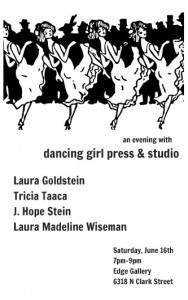
Chicago reading

I’m reading from my chapbook SHE WHO LOVES HER FATHER tonight in Chicago with fellow poets J. Hope Stein, Laura Goldstein, and Tricia Taaca. Some of these you’ll see as future chapbook interviewees. I hope to see you there and to wet your appetite a few of the poems from my new chap are sampled on extract(s).

Reading (poetry) with Dancing Girl Press authors J. Hope Stein, Laura Goldstein, & Tricia Taaca
7 p.m. Saturday, June 16, 2012
The Edge Gallery
6318 N Clark
Chicago, IL 60660

Footage and photos forthcoming. See you soon!

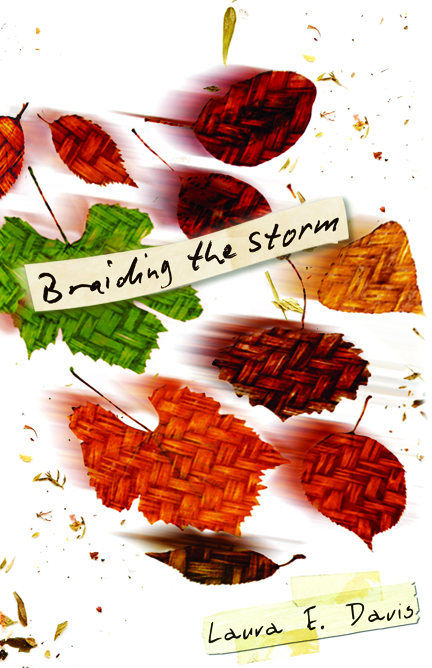
The Chapbook Interview: Laura E. Davis on First Chapbooks & Coming of Age

How did your forthcoming chapbook, Braiding the Storm, begin?

I was in my last semester of graduate school at the time, so I was already compiling a larger manuscript for my thesis. I decided to submit to Finishing Line’s New Women’s Voice contest, so I just collected poems that fit with the narrative arch I was already working with. I pretty much put it together for a few contest deadlines. Thank goodness for deadlines.


How long did you spend writing it? How many versions did it go through before you reached the final?

These poems were written between October 2009 and January 2011, mostly looking back on the path that lead me to accept that I was a poet. I didn’t think that I was writing a chapbook at that point. I was just writing the poems I needed to write. For me, a manuscript is never really finished. I see poems the same way. We might prefer a version and stop there for aesthetic, personal, or practical reasons, but this particular version has to do with the contest deadline.

Tell me more about the “coming of age” theme. How did you decide upon the order of the poems, the narrative arc, and the various themes such as those introduced in your flagship poem “The Vicenarian or My Twenties So Far”?

The collection is a journey through my late teens to my late twenties. I had some pretty intense emotional experiences during that time: defining my sexuality, dealing with a sexual assault, developing my own political and religious opinions, struggling with mental illness, getting married, getting divorced, moving a lot, losing family to illness. My twenties were turbulent. I’m definitely not alone there, which is why a lot of the themes are universal.

As I was writing a number of the poems in the chapbook, I struggled with fully expressing the weight of my twenties through individual poems. That’s when I read Brenda Hillman’s epic prose poem, “The Eighties”, where she layers the personal with the political and cultural climates of the decade. It blew me away. Sometimes there are poems that change your life. That make you think, “I didn’t know I could do that!” Hillman’s poem did that for me. So I wrote an imitation poem which eventually became “The Vicenarian or My Twenties So Far”. I put everything in this poem. All of the turbulence that characterized my twenties. Writing it was so cathartic, but more surprising were the responses when I read it out loud for the first time. This poem resonates with people, particularly those my age, but not exclusively. My mentor, poet John Oliver Simon, said he could write one for each of the six decades of his life. There is something for everyone to latch onto there, I believe. So it made sense to put this poem at the beginning and have it inform the rest of the poems, which for the most part are organized chronologically.

I should mention that not all of the poems, nor any individual poem, is completely autobiographical.


How much time did you spend to find a home for it?

I was lucky. I sent this to four contests. I didn’t win any of them, but I also never received a formal rejection from Finishing Line after they announced their contest winners, and I knew they considered publishing all contest entries. Still, I was preparing to do an overhaul of the manuscript to include newer poems when I got the acceptance in December 2011.


What about the publication of the individual poems prior to the acceptance from Finishing Line Press? Did you seek to publish these poems in print, online or a mix? Is there a balance you prefer of published and unpublished poems in a collection?

Many of these poems have been previously published in both print and online journals. I don’t really think about a mix of print or online, or at least I wasn’t at the time. I just sent work to publications I admired, who published the work of poets I admire. I wasn’t going for a balance. The individual poems were separate entities until I printed all the poems out last January, laid them on the floor, and sequenced them. That’s when I though, “This is a chapbook.” It was just by chance that I chose some of the poems already published.

Tell me about that cover art, design, and layout. How involved were you with the selection of cover art and the overall chapbook cover and interior layout and design?

The cover art was created by my friend and photographer and digital artist Rose Desiano. I was so happy to work collaboratively with Rose on the cover. I wrote about this process on my blog.


What was the time between acceptance of your chapbook and publication date? How much editing of the poems and manuscript did you do during this time? When did you know, really know, Braiding the Storm was done and ready for the world?

The time span seems endless – about nine months from acceptance to publishing – though I had about half of that time to get the final manuscript to FLP. I was surprised and pleased with the flexibility the editors gave me in terms of editing the manuscript. I ended up swapping out one poem with another and making minor edits to a handful of poems, including adjusting the line breaks to fit within a chapbook’s margins. I didn’t really know it was finished. I still don’t. It feels mostly done.

Has being the editor and founder of the journal Weave Magazine shaped your writing and sense of the publishing industry in some ways?

Absolutely. The biggest effect editing Weave has had on me is realizing the importance of community in writing. Even though I haven’t met most of Weave’s contributors in person, I’ve developed relationships with many online and through email. I cherish these connections. They are essential to doing the work that goes with being writer and so many of my contributors have influenced my own writing: Sally Rosen Kindred, Rachel Bunting, Nicelle Davis, Mary Stone Dockery, and many more.

Weave has also helped me realize that editors aren’t scary. They are just people. Very busy people. I do my best to support the publications I really love and believe in. So in this way, it’s made submitting my writing less intimidating. A rejection can mean many things, but almost never means, “you and your poems aren’t good enough.” Maybe I caught the editor on a bad day (this happens). Or the first readers weren’t drawn to my style. Or they already have a poem about fruit flies for the upcoming issue. Or they don’t typically publish sestinas. Whatever. I’ll find a home for them eventually.

What current projects are you working on?

I have a couple of writing projects, though I use that term loosely. It’s more like I’m better now at recognizing the emotional patterns and landscape of the poems I write during a particular time period. Right now I have a first draft of a collection that is very different than Braiding the Storm – mostly second and third person narratives about invented characters or archetypes. My recent move from Pittsburgh to San Francisco really shook me. I couldn’t write anything personal. I was too close to those experiences. Just now, after almost a year of living in San Francisco, I’ve returned to writing poems about myself in this strange place, identity, the displacement I feel, the meaning of home. I’m looking forward to seeing how these poems take shape. I think these will likely be a longer manuscript, while the character poems are probably another chapbook.


Number of chapbooks you own: At least 40.

Number of chapbooks you’ve read: I have no idea. At least 40? I just got a bunch of new ones I haven’t opened yet though.

Ways you promote other poets: My blog, Weave, social networking, writing reviews, Submission Bombers.

Inspirations and influences: Brenda Hillman, Aimee Nezhukumatathil, Dorianne Laux

Residence: San Francisco, CA

Job and education: Freelance writer, editor, educator, translator. B.S. in Education, M.F.A. in Creative Writing, Poetry and Creative Nonfiction

Bio: Laura E. Davis is the Founding Editor of Weave Magazine. Her poem “Widowing” won the 2011 Crab Creek Review Poetry Contest, judged by Dorianne Laux. Her poems are featured or forthcoming in Sweet Lit, Super Arrow, The Splinter Generation, and Redactions, among others. A native of Pittsburgh, she now teaches poetry writing, translation, and recitation in San Francisco, where she lives with her partner, Sal.


The Chapbook Interview: Susana H. Case on Heat

How did your new chapbook, Manual of Practical Sexual Advice (Kattywompus Press, 2012) begin?

I was cleaning out my parents’ home after they died and found a well-thumbed sex manual from the 1940s in the drawer of a bedroom table. My parents were from that generation of Americans who believed in relying upon manuals for everything. Dr. Spock wrote their household bible on child care. Anyway, I took the manual home, forgot about it, and found it again years later when clearing out my own furniture. This time I decided to read it and it got me speculating about my parents’ sexual life, in particular, that of my mother. The doctor who wrote the 1940s manual was well-meaning, but constrained by notions of gender and female sexuality in the mid-century. His portrait of what was expected for a “normal” sex life was not pretty. I decided to channel him and to also respond to him. In a way, that chapbook is a conversation between a sexual advice “expert” of the mid-twentieth century and a modern woman.

How long did you spend writing it? Was research part of your writing process? How many versions did it go through before you reached the final? How did your peers and readers shape the revision process?

It went through a couple of enjambed versions before I decided that a prose poem structure would work better for most of the poems in the manual. I belong to a writing group that meets weekly and so during the time I was working on the series, I brought parts in for our meetings and took those comments into consideration when revising, though the prose form structure came later. I spent about six months working on the manual, but I usually have a few series going at any one time.

I did research on the period because I wanted there to be historical accuracy. For example, I looked into the use of strychnine as an aphrodisiac and also looked into common but peculiar foods from the period for one of the poems. I’m interested in general in using history in poetry, not only my own social history, but history in the larger sense.


How much time did you spend finding a home for it?

Not too long, actually. I had sent it out a couple of times before changing to a prose poem structure. Once I changed the structure, I found a home for it right away.


Tell me more about the poems and themes in Manual of Practical Sexual Advice. I’m fascinated with the idea of manuals and how-to-books. There’s something so hopeful in a how-to, as if it can offer answers and give solutions to ones problems in a few easy steps. I think Manual of Practical Sexual Advice seems to point to the oddness of such books, especially when certain subjects, have been and still are in certain circles, taboo. How did you go about putting such a sequence together?

I looked to see which topics were commonly covered in advice manuals of this sort. The poems are not an exact replication of topics. I consolidated and changed things around to suit what I wanted to write about and tossed out what I thought was weakest. You know that old aphorism about jewelry—remove one piece after you think you’ve finished putting yourself together? I think it applies to poetry series as well—remove one poem, maybe even two, once you think you have finished. In terms of the taboo nature of the material, a friend and fellow poet told me when another friend of his visited him, she saw Manual and asked him what he was doing with porn in his home! I don’t see it that way, obviously. Perhaps some of the poems seem a bit naughty, but the intent is quite serious.

Desire and heat are also themes in your chapbook The Cost of Heat (Pecan Grove Press, 2010). How are these two collections different?

Both are, in a sense, personal, but The Cost of Heat is more explicitly so. The poems in that series are based upon my second marriage and are my attempt to explore what domestic intimacy has meant for me. Because my husband is an artist, I’ve also thought a lot about the ways in which two creating people mesh together well and the issues that situation engenders. Although Manual of Practical Sexual Advice was generated from my look backward at the early years of my parents’ lives together, there’s more of an attempt in that series to place their lives within a socio-historical context.


What about the publication of the individual poems prior to the acceptance from the press? Most of the poems in The Cost of Heat first appeared in print. Do you seek to publish your poems in print, online or a mix? Is there a balance you prefer of published and unpublished poems in a collection?

There’s something about holding a literary magazine in my hands that appeals to me. On the other hand, there are so many new and interesting online venues that I feel it’s important to explore. Some of it I recognize as economic for publishers. One in-print literary magazine that I very much admire, Cider Press Review started as a print journal and made the switch, I suspect, for reasons of production costs. So, I pursue both forms of publication. In terms of the publication of individual poems, I thought the poems in The Cost of Heat could stand alone and that’s why most of those were previously published. The Manual poems were newer and also most were probably going to be viewed a little strangely as stand-alones-they needed more context. Only one of those was ever sent out to a literary magazine beforehand and that one appeared in Coe Review. It was an older poem, written before I was aware that I was writing a series.


Tell me about the cover art, design and layout of Manual of Practical Sexual Advice and The Cost of Heat. The cover image is just perfect for Manual of Practical Sexual Advice. Too, I love the cover artwork on The Cost of Heat. The artwork is your husband’s right? How involved were you with the selection of cover and the interior layout and design?

I suggested the cover of The Cost of Heat. I wanted to use a detail of one of my husband’s works, because the poems referenced my life with him so much, and I wanted a cover that evoked heat, so although much of Eric Hoffmann’s work is monchromatic, he has used red in a very few paintings, and I was interested in using one of those. I had a lot of discussions with Pecan Grove Press about cover font as well. With Manual, the chapbooks of Kattywompus Press all have a similar signature in terms of cover art, so Sammy Greenspan, the publisher, had her own clear vision for the cover and checked to make sure I was okay with it. I’m happy about how both covers worked out. The inside layout was largely in the hands of both presses.


What was the time between acceptance of your chapbook and publication date? How much editing of the poems and manuscript did you do during this time? When did you know, really know your chapbook was done and ready for the world?

I think each chapbook took about a year from acceptance to publication. During that time, I did not do a lot of editing of either. But then I got page proofs and got a bit more sniggly. I’m not sure they’re ever really done, but to the extent that they’re treated by me as done, when I send them out for consideration, I feel they’re substantially done.


Once you’d sent the final version of your chapbook to the press, how long did you wait until you had the chapbook in your hands? What did you do during this time?

I think it took several months in both cases. Kattywompus does their printing in-house, but puts out more chapbooks per year than Pecan Grove Press. I continued to work on other poems.

It seems there might be a lingering sense among some poets, writers, and editors: poets must win prizes. Even the May/June 2012 Poets & Writers discuss the necessity of contests to bolster memberships for journals, covering part of running and managing a contest, and creating opportunities for writers of poetry and short story collections a venue for publishing their books and chapbook. You’ve won a couple of chapbook prizes. What advice would you offer other poets considering contests and open reading periods for their chapbooks?

I consider it a useful way for an unknown poet to launch a first collection. And it’s a good venue for a smaller series anytime during one’s career trajectory. It also helps support the publication efforts of small presses. I had won a chapbook contest years earlier—that of Slapering Hol Press, for a manuscript titled The Scottish Café, so I knew what to expect. That one mushroomed into a Polish-English translation published by Opole University Press. My experience has been that the experience leads to other opportunities. I’ve gotten to know a number of other Slapering Hol Press poets and for many, their chapbook competition win was the beginning of further successes.

Has winning a chapbook prize changed the way you approach the business side of writing?

I realized that the burden of promoting a chapbook-any poetry book really-falls upon the author and takes a lot of work. I also had another chapbook published by Main Street Rag Publishing Company before these two more recent ones. So I’m used to the process. I did think, however, that it was time for a full length collection. Or maybe I felt internal pressure because it seemed almost everyone I knew had a full-length book coming out. I have one forthcoming now from WordTech Editions: Salem in Séance. It’s based upon personalities from the Salem witchcraft trials and is due out in January, 2013.

Given that both you and your husband are artists, does that influence your writing?

Absolutely! Aside from the fact that it provides subject matter, there’s a way in which living with someone who is equally obsessed about their work makes it easier to explain why I can’t talk right now and I can’t listen either because I am shutting myself up in my workspace and you’ll see me later. It’s nice to have that and not have domestic conflict over it. The other person understands the obsession.


What current projects are you working on?

I’m working on a series of poems inspired by rock and roll. I have an interest in labor history as well and I’ve been working on a series based upon copper mining.

Number of chapbooks you own: I don’t know exactly-100?

Number of chapbooks you’ve read: I’ve read at least as many as I own and others I decided not to keep.

Ways you promote other poets: After Slapering Hol Press published my first chapbook, I was invited to join their Advisory Committee. One of my volunteer activities is working in an e-newsletter that gets sent out three times a year.

Where you spend your poetry earnings: You’re joking, right? If there’s prize money involved, I’ll treat myself to a bauble.

Inspirations and influences: I love the postwar Polish poets, but also enjoy a range of contemporary poets. I’m studying Italian, so I’ve had the opportunity to read a number of contemporary Italian poets in the original. Their poetry seems very different-often more abstract and of course, the sound is different because there’s more internal rhyme because of the nature of the language,

Residence: New York City

Job and education: I work as a university professor and have a Ph.D., in sociology. That probably accounts for my interest in certain subjects.

Bio: Susana H. Case, professor at the New York Institute of Technology, has recent work in many journals, including Hawai’i Pacific Review, Portland Review, Potomac Review and Saranac Review. She is the author of the chapbooks The Scottish Café (Slapering Hol Press), Anthropologist In Ohio (Main Street Rag Publishing Company), The Cost Of Heat (Pecan Grove Press), and Manual of Practical Sexual Advice (Kattywompus Press). An English-Polish reprint of The Scottish Café, Kawiarnia Szkocka, was published by Opole University Press in Poland. Her book, Salem In Séance (WordTech Editions) will be released in 2013. Please visit her online at: http://iris.nyit.edu/~shcase/.
 

First Friday Prairie Center Reading

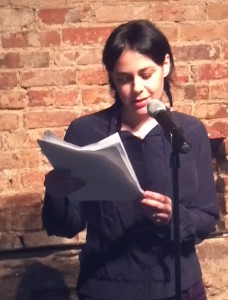
Last night I read with two other wonderful writers at PCA for first Friday. It was so nice to hear fellow residents read from their work. The reading took place in a little nook in K-3 studios, with lots of comfy couches, exposed brick walls, and platters of delicious nibbles of cheese and crackers, grapes, and chocolate chip cookies.

Reading (poetry & prose) with April Flynn & Katey Schultz, CIAO Peoria at Prairie Center of the Arts
7 – 8:30 p.m. June 1, 2012
1506 SW Washington St., K-3 Studios
Peoria, IL 61602

I read from my forthcoming chapbook SHE WHO LOVES HER FATHER that is due out a little later this month. (Speaking of, I’m doing a reading in Chicago on June 15 at the Edge Gallery to officially launch the collection with Dancing Girl Press & Studio).

I also read from a digital collaboration that I’m working on with another resident. I hadn’t been down to the Cordage Building and the K-3 studios since my last residency here when I was working on my broadside collaboration. PCA has done a lot of work to the studios. The space was bright, welcoming, and friendly. Plus, I got to wander around and look at what some of the visual artists had created.

Thanks to my fellow readers, to Michele and Joe Richey for hosting the event, to Adam Wagler for his technical savvy, to April Flynn for stepping in as videographer in a pinch, and to the Prairie Center for creating such a perfect space to write and reflect, and for creating opportunities, like this one, to read and present new work. I couldn’t think of a better way to spend my first Friday.