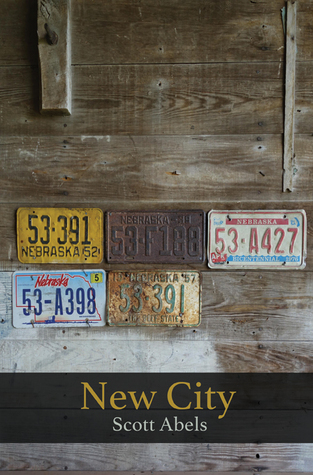
You are the author of the chapbooks A State of The Union Speech (Beard of Bees Press, 2015) and Nebraska Fantastic (Beard of Bees Press, 2012), as well as the full-length books Rambo Goes to Idaho (BlazeVox, 2011) and New City (BlazeVox, 2015). You also have a MFA from Boise State University. What did you learn during your MFA studies and undergrad degree in literature about the chapbook?
I think the best approach I found to writing poems in grad school was to decide that the goal of writing a poem was simply to get me to the next poem—which is a way of saying I wasn’t thinking much about publication back then, happily, just trying to generate as many different kinds of poems as I could and to keep moving forward (and, yes, the never-ending workshop deadlines do help you keep moving forward). We were reading a lot of Jack Spicer back then, trying to get our heads around the idea of the “serial poem,” which seemed to have two priorities: 1) the idea that poems don’t live very well by themselves, but just seem to be more productive in groups (not everyone agrees with this, of course, but it seemed a lot more important than the well-crafted poems in The New Yorker, which I’ve heard described as delivering the perfect feeling of a pat on the as—yes, I enjoy a pat on the ass, but I want poetry to do more than that), and 2) the spirit and energy of the myth of Orpheus, which demands that one keeps moving forward, and, at the risk of death, never looking back, as if the life of the poem ends if there is a pause and a backward glance. Then one year Robin Blazer (who formed one third of the triad of Robert Duncan/Jack Spicer/Robin Blazer, a crew which did a lot for poetry in America) came to read at BSU, and that whole idea of serial poetry became a bit more contemporary for me, while also demonstrating how important extended poetry communities are to generating poetry. Other longer, experimental lyric sequences that I found (and still find, in different ways) generative include the work of Ted Berrigan, John Berryman, and Alice Notley. So I think most of us in grad school were thinking not about poems, but about books. Martin Corless-Smith taught a tremendous class on poems as books, which, arguably, is very much a British and American poetic tradition from Milton to Blake to Whitman and so many others. And, of course, there was this great experimental poetry press right there—Ahsahta Press, brought back to life right in front of us by the strong editorial guidance of Janet Holmes—which always had us thinking about the book’s place in writing individual poems. And so, it occurred to most of us that a longer sequence was just more interesting than writing a short lyric and then seeking publication for it. Of course, I keep saying “book,” while I am being asked about the “chapbook,” so, to clarify, I am using the term “book” inclusively and expansively, which works for the purpose of this conversation. Chapbooks are a short book format-but are still in every way “books”—which perhaps offer a more accessible set of attributes (they are smaller, more portable, cheaper to produce, potentially more approachable to readers, etc…).
Your chapbook A State of The Union Speech tackles issues of sustainability, agriculture, big agribusiness, and government. What inspires you to write and what inspired you specifically to write your new chapbook?
There is a sort of creative writing classroom cliche that says that you write a novel to say or do the things that only novels can do, you write a play to say or do the things that only drama can do, and you write a poem to say or do things that only poetry can do. Though I’m not entirely sure what that all means, it does help me think about the things that poetry is particularly good at. Poetry is very good at rendering memory, poetry is great at comedy, poetry is great at helping us have a conversation about politics and/or power dynamics, and poetry is really great with absurdity—which, along with a tolerance for ambiguity, is, I think, essential to imagination. And so, although a lot of the politics which that particular sequence of poems takes on are very real, vital, and sincere, I wonder if (or, rather, I hope) the value can really be found in the absurd otherworldly atmosphere of the poem—which is to say I hope it is fun and that it might even help people with their imagination.
As far as what inspires the political content-sustainability, agriculture, big business, and government—of the chapbook, perhaps that comes from the process of composing the poem. It mostly comes from the news (or the news I read, which must somehow reflect what I’m trying to pay attention to). If poets are always listening to language, then a lot of the language I find amazing (hilarious, otherworldly, imaginative, etc…) comes from the news. But of course it becomes those amazing things when the context shifts; isn’t that what metaphor is: the magic act of bridging an impossible distance by placing two fantastically distant yet specific things side by side as if it’s just the most natural thing in the neighborhood. And so, I admit that an awful lot of the language in my poems is a collage of news headlines, news phrases, and conversations among strangers that I overhear by chance. That’s a lot of the language that surrounds me, I suppose, coherent or not, and the game of piecing the ensemble together gives me great joy.
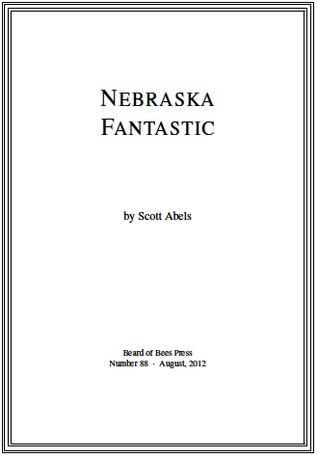
Yes, I can tell that about your work—your delight in the language and the play of the way words are put together by others. Reading your work makes for a provocative and joyful read, even at a cursory glance, like perusing the titles of your poems. I adore the title of your chapbook Nebraska Fantastic and the individual titles of your poems. Tell me about your use of titles and the poets and the collections you admire who title with verve and style.
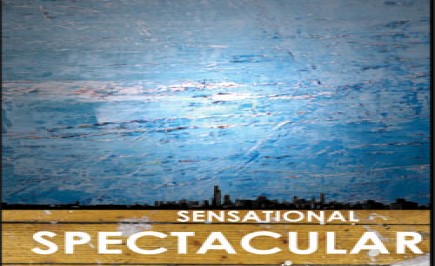
Thanks! Earlier, I had mentioned influences such as Spicer, Berrigan, Berryman, and Notley, and I will also point to those poets in the context of great titles. As far as younger poets, I would add Nate Pritts to the list of great titlers, as he’s not afraid of indulging in grand superlatives—as in his Sensational Spectacular out with BlazeVOX [books]—to express a contemporary romanticism, which reminds me that the two-thousand year old tradition of messing around with what it means to say “I” in a poem (articulation of self-hood) isn’t yet exhausted, at all. Also, Michael Earl Craig stands out as a contemporary master of titling (Yes, Master; Can you Relax in My House; Thin Kimono), being capable of both grand humor and grand heart, simultaneously.
I wrote Nebraska Fantastic during the years that I taught English (as a second language) in rural Mexico, which is to say I was swimming in English that was being spoken by folks who were just beginning to learn the language. So much of that language was amazing—really, that kind of astonishing syntax and vocabulary, with its unique and authentic balances and imbalances and risk of failure—and I say that out of a real respect for how difficult language acquisition is. Having also taught English (as a second language) for many years in Hawai’i, so much of the language I heard on the job was making its way into my poems, which then began to grow into a long series that took the point of view of an English language learner attempting to make sense of a foreign country in a foreign language (English). It just now occurs to me that those poems were an exercise in dictation—that old practice of recording the voice of a distant or imaginary character. When it came to the point where I let a few editors look at those poems, a few people had the sense that the poems had the effect of mocking the speaker, as if that was my intention. This of course mortified me, and the poems were destroyed. And so, to be clear, despite what I really think were my best intentions, I acknowledge that project was a mistake, as the risk of offending groups of people in that context was never a risk I thought was worthy or interesting. Having said that, I think that a certain awkwardness is important to my writing, and I suppose this is where a lot of that awkwardness comes from: having lived a few years within a number of layers of language barriers, and inviting those layers into my work. The idea is that the challenges of translating a language and translating an experience (or memory) aren’t really so different, and the imbalances and breakdowns involved are important. Thus, in that chapbook, I tried to play with Nebraska as someone who had never been to Nebraska, as an imaginary extreme outsider, even though I did indeed grow up there, and anyway Nebraska was on my mind, from many thousands of miles away.

I love the cleverness of your poetry. For example, your poem “Nebraska Family Tree” includes two keys, the first with notations like EF for excessive firearms and SRP for strong religious preference. Your notes indicate a thanks to a relative who complied a family tree. Talk about navigating familial truths in poetry
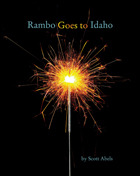
Thank you for saying so, and for posing this good question. Both of my books are often approached as “semi-autobiographical,” and I do not know why. I’m not being coy here, I really don’t know why. I’m from Nebraska and I have a number of poems about Nebraska. I have an MFA from Boise State University, and the speaker of Rambo Goes to Idaho is also an MFA student at that same school. So I get that the basic frame sets up an “semi-autobiographical” reading on a surface level, but I don’t think such a reading holds up in any interesting way beyond that. And, more importantly, I think that an autobiographical focus does nothing for the poems—but it probably does hold them back from whatever they are. So you ask a great question here, and my response is that I try very hard not to navigate actual familial truth through poetry. Others do this very well (Maggie Nelson’s handling of her aunt’s death in Jane: A Murder is a masterful example). I’ve heard poets such as Matt Hart state something close to the notion that there is never a speaker in their poems—which is to say the speaker in their poems is never a construct, but the actual poet speaking through the lyric “I” (perhaps that’s the fingerprint of the so called “New Sincerity” poets, if you were to discard all the Tao Lin hipster self-absorption). The idea of the poet speaking directly to the reader is a great way to read Whitman, I think, but a bad way to read my work. Yes, my “Nebraska Family Tree” sequence spans five generations in Nebraska, quite like my own family, but that’s numbers that form the frame, not the emotional content. And, yes, some of the language and structure of the sequence are credited to my mother’s excellent work with our family tree, but there is no useful correlation between the book’s characters and my own ancestors—maybe there are a few original characteristics, but the addition of fictitious characteristics removes the entire sequence from my actual family, as in Denise Riley’s wonderful notion of interpolation (if you introduce new elements into a thing, the whole of the thing is fundamentally different than the original elements—it is a new whole thing). Or maybe a more conservative maxim would be Richard Hugo’s good advice that if the barn was red but it needs to be yellow for the poem, you make the barn yellow.
How do you define chapbook? I think it’s a short book—loosely speaking, it’s a size somewhere in between a book and a pamphlet/broadside. It’s a form most popular with poets, I think, though there are plenty of fiction chappies coming out. And what complicates the idea of chapbook is the popularity of e-chapbooks, which makes sense to me (though some folks consider this an oxymoron, as you can’t put an e-book in your pocket; I think that’s a silly reason to reject e-chapbooks, as the idea is portability, which the internet is great at). I bring up e-chappies because the form reminds me that chapbook makers often have the ethic of low-cost (both production costs and cost to the consumer) and also ease of production.
What makes a good chapbook? Often it’s great poems made by low tech/low cost production. But of course there is a huge range of production values to fit great poetry, from pdfs to letterpress.
What chapbooks are inspiring you these days? I’ll answer this by naming some publishers. The New Megaphone, Horse Less Press, Dancing Girl, and Sixth Finch have been putting out good stuff in recent years.
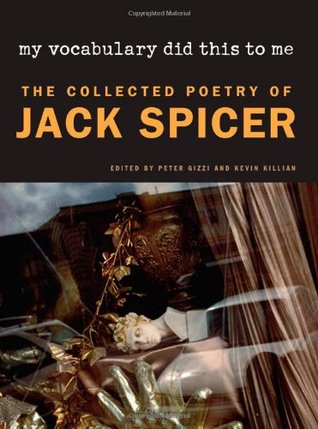
What chapbooks or chapbook poets have impacted your writing the most? Jack Spicer’s poems are back in print as “Collected Poems,” thanks to Peter Gizzi (you can still find Spicer’s Robin Blazer edited “Collected Poems” but it’s expensive and out of print). But I would argue that a lot of the poems in that book were published as chapbooks by micro-presses. Boise State University (where I went to grad school) happened to have a number of first-edition Spicer chapbooks, which I used to check out and spend time with long before I realized how rare those copies were. It was a lot of fun to read his Billy the Kid in its original format.
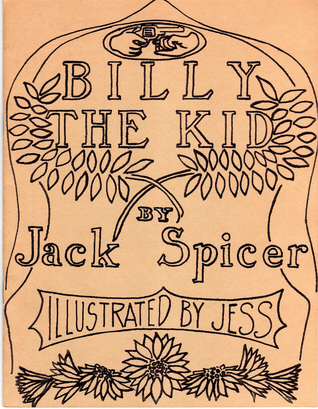
What do you look for when you put together a chapbook? Oh, it has to work together as a whole, just like a book. So I suppose I have the same criteria as a book, just within a smaller size/scope. That’s sort of a simple answer, but it does feel that simple to me.
How are you trying to get better as a chapbook poet? By trying to be patient. These things take time-a lot more time than they used to for me. But I think the result is that though I’ll take a lot more time to put together a chapbook (and lately my book-length manuscripts are a combination of several linked chapbooks) than I used to-maybe a year more than I used to-the end product is much better. I stopped self-publishing a number of years ago-which maybe is a bummer-but working through the publication process does help slow things down, and anyway rejection has helped me eliminate a lot of weak writing. And part of being patient is not worrying about output. Sure, most/all writer’s have feeling of guilt for not writing enough, but I hope we also all recognize that these things come and go, and come again.
What’s next for you? I’ve been deleting a number of poems that I have wrongfully been attached to in the last two years, so, as I’ve mentioned above, I’m taking my time with about ten good poems. Some of these are published, some not yet, but I’m looking for the thread(s) that will help them grow into a chapbook-size thing. It’s probably called Well, but maybe it will become No Hunting.
Current chapbook reading list: Chad Reynold’s Esu-Dei-Vie
Number of chapbooks you own: Probably 50.
Number of chapbooks you’ve read: Oh, I just really don’t know.
Talk about your commitment to the chapbook writing community. Maybe I’ll turn the question and say what the chappie community has done for me. Earlier I mentioned Beard of Bees and Publishing Genius as publishers of e-books. Also, Moria. These first became important to me because I was living in rural Mexico, where I didn’t trust the local postal service, and so the internet was my primary source for poetry. That was pretty important to me, being lonely in a foreign country.
Ways you promote and serve other chapbook poets: Not sure I’ve done so much, but issue six of my online poetry journal Country Music is all PDF chapbooks. I am proud of that issue. I wish I had more time (took more time) to review the work of authors I like. I’ve done that a bit, but not enough. If you’re looking to get your name out there, review books! Everybody’s looking for reviews, and everybody’s also looking to get reviewed, so do the work and fill the void.
Your chapbook credo: There is room.
Alternate credo: Bring back fun.
Where you spend your chapbook earnings: I’ve published my chapbooks with Beard of Bees, and the most chapbook thing about them is it’s all for free. It’s done for free, and it’s available for free. It’s what sometimes gets called the small press gift culture.
Your chapbook wish: Flood the market!
Residence: On the farm, near Stanton, Nebraska. My great-great-grandfather homesteaded the property.
Job: I teach English at Northeast Community College, where I also coordinate the ESL and Developmental English programs.
Chapbook education: In grad school, we’d be sure to crank out a homemade chapbook at least once a year (usually by unauthorized use of the English department’s copy machine, but sometimes we’d skip the bar and go to Kinkos). We, a small circle of use, didn’t worry about publishing much at the time; I think that hand make work was a way of moving on to the next thing. But I also think that was the beginning of a very real object worship with the concept of books (yes, that applies to online design as well).
Chapbook Bio: Scott Abels is the author of Nebraska Fantastic (Beard of Bees, 2011) and A STATE OF THE UNION SPEECH (Beard of Bees, 2015).