the chapbook interview: Julie Danho on the punctuation of poetry

Julie Danho photo

I love your use of punctuation as titles in Six Portraits. You open your chapbook with the epigraph from Jennifer DeVere Brody, “Punctuation marks can serve as both sense and sensibility—as the most human element in certain sentences,” an epigraph that speaks to the tension you create in your poems as you consider issues of family and love. Talk about your interests in punctuation and poetics.

I’ve been working as a copywriter since I finished my MFA, so now I’m more of a grammar and punctuation geek than ever before. Punctuation is so often used incorrectly, but its use—and misuse—can have a tremendous impact on a sentence’s meaning. I always thought of each mark as having its own identity, and these poems were a way of exploring that. I found the “.” poem the most difficult to write because the period is really the king of punctuation. All the other punctuation marks in the book (except the parentheses) are visually derived from the period, and the “.” poem is about the struggle of coping with power. I placed each of the six punctuation poems with two other thematically related poems to create the six portraits in the title of the book. For example, the “.” poem is in a portrait with two other poems about “stops,” or, specifically, deaths: “When the First Father Dies,” and “On Seeing the Bag of John Lennon’s Bloody Clothes.” But it’s not quite as morbid a portrait as it may sound!
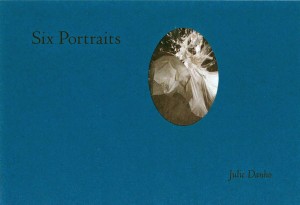
Six_Portraits Julie Danho
Jeffrey Hecker’s chapbook Hornbook and Katrina Vandenberg’s book The Alphabet Not Unlike the End of the World look at the shape typography makes of letters, much like the work you’re doing in your poems “?” and “!”. Likewise, some of the poems in Six Portraits move from the ekphrasis to wonder why and how art was made. Can you talk about your dazzling impulse to approach punctuation as art?

“?” was the first punctuation poem that I wrote, and it was actually inspired by a book that Melissa Khoury, a close friend who is a graphic designer, was writing about typography. Her book explored the history of each letter’s visual representation, and she photographed letters in unusual circumstances, including a “y” frozen in an ice cube. I loved the idea, and I started looking at punctuation in a similar light. Many of my other poems take art as a starting point, so the idea of looking at the question mark as an art object makes sense, although I don’t think it was a deliberate move at the time. In the book, I placed the “?” poem with two poems about art pieces—both of which question whether a work actually is art—to create the first “portrait” of the book. While none of the other punctuation poems focus as explicitly on art, “!” and “,” both also play on the punctuation’s shape. I tried to give each punctuation mark its own persona, and some of the later poems focus more on the use of the punctuation mark than its look.


Many of the poems in Six Portraits address issues of grief and loss, joining the rich tradition of poets writing of these issues, such as Emily Dickinson’s “I measure every Grief I meet” and Elizabeth Bishop’s “One Art.” Were you ever scared to write about such topics?

Absolutely. But I was actually much more anxious about showing the poems to the people I’d written about over the years. About a half hour after I received the incredible news that Slapering Hol was publishing my chapbook, I realized that I had to show some of my friends and family the poems I’d been keeping from them. Many of the poems in Six Portraits about grief aren’t about my own losses. Instead, they’re about the helplessness I feel—that so many of us feel—when someone we love is grieving the loss of a child or parent. And, of course, we can’t help but fear that grief coming to our own door. It ended up being a really good thing to have those conversations with the people I’d written about. They liked the poems, and I felt that I’d said something to them in print that I wasn’t great at expressing in person.
Let’s talk press and publication. Do your poems, in their final form, turn out the way you want them when they reach the readers’ hand on the printed page of the book? How does the form of the book constrain or free your poetic expression?

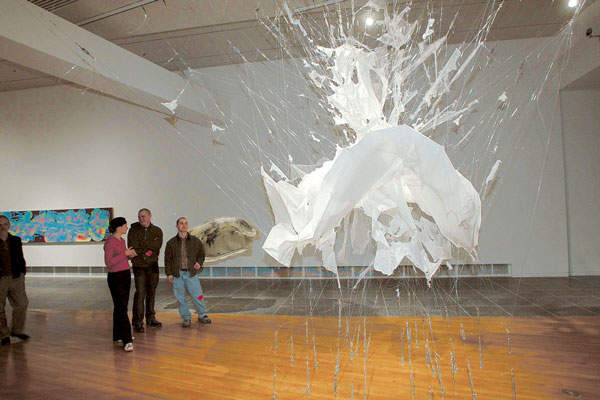
Because a lot of the poems in Six Portraits are about art, the way the book looked was really important to me. I’d always imagined the cover of my first book being Bombshell, this incredible sculpture by the artist E.V. Day. Made of fishing line, turnbuckles, and fabric, the sculpture looks like Marilyn Monroe’s white dress blowing up in The Seven-Year Itch—if Marilyn Monroe’s dress had exploded. My poem, also titled Bombshell, is shaped to look like the sculpture. I had first seen the work in The Wexner Center for the Arts on the Ohio State campus, but it’s now owned by the Whitney Museum. Margo Stever, co-editor of Slapering Hol, was tremendous in working with E.V. Day to get permission to use the image, which E.V. Day graciously donated.

A lot of the poems in the book have long lines, so the book’s designer—Ed Rayher of Swamp Press—put it in a landscape format that complemented the book’s structure. It’s beautiful, which I can say because I definitely can’t take any credit for it. Slapering Hol is known for putting out lovely chapbooks. So I’d say my poetic expression was freed in ways I never dared expect.
Given that you’ve just had a first chapbook released from Slapering Hol Press, what’s the influence of performing your poems on your writing—does the anticipation of reading or giving readings influence how your work appears on the page?

When I’m trying to decide if a poem is finished, I sometimes ask myself if I’d choose it over other poems to read in front of an audience. If I wouldn’t, the poem either might not be done or it might not be worth finishing. But I also have poems that I just think work better on the page. For example, the punctuation poems in Six Portraits play with how the layout of the poem relates to the punctuation mark, so I do think they come across differently when read aloud.
What is inspiring you these days? How are you trying to get better as a poet?

I always find reading the work of other poets to be inspiring. If I’m in a writing slump, I often realize that I haven’t been reading enough poetry. I also find that being a spectator for other arts—whether by going to an art museum, the ballet, or the theater (all of which I love)—can also help me come up with new ideas. I’m trying to get better as a poet by working more steadily. I believe much more in writing every day rather than waiting for inspiration, but it can be difficult to do with a family and a full-time job. I’ve been better about it this year than I have in a long time, and I find I’m enjoying that time more than ever. My husband, David O’Connell, is also a poet, and he’s an amazing editor. So I’m really lucky to get help with my poems without even leaving the house.

Your chapbook credo: A shorter format offers room to experiment.

Number of chapbooks you own: About 30

Number of chapbooks you’ve read: Probably around 50

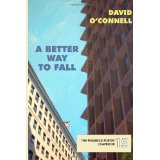
Ways you promote and serve other chapbook poets: I support other chapbook poets by buying their work, going to readings, and lending their wonderful chapbooks to other readers. My favorite chapbook to promote is A Better Way to Fall, which is a great collection by my husband David O’Connell.

Where you spend your chapbook earnings: I bought a slice of my favorite Russian Tea Cake, a cappuccino, and some extra copies of my chapbook to sell at readings.

Your chapbook wish: That more people appreciate this unique book format

Residence: Providence, Rhode Island

Job: Copywriter/Editor

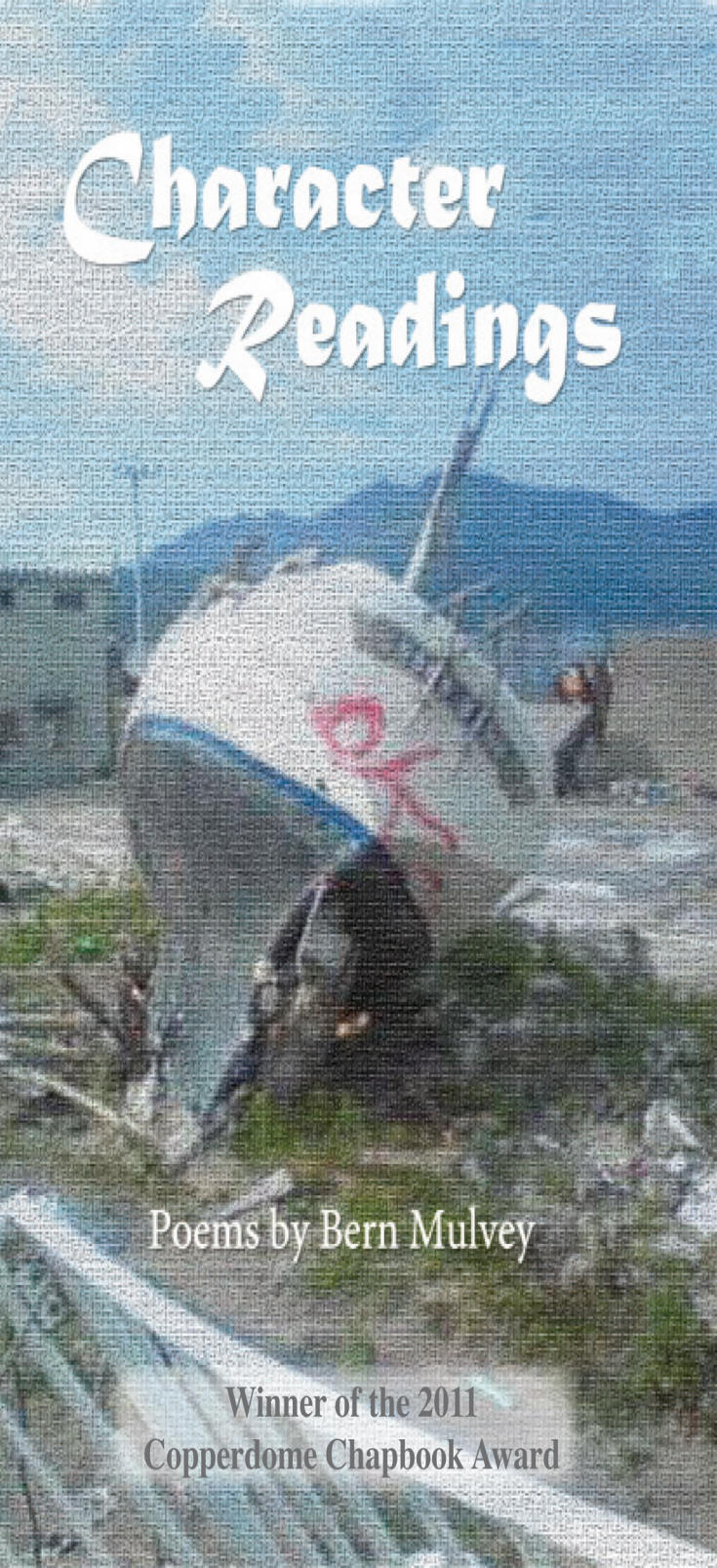
Chapbook education: I actually learned a lot by losing chapbook contests. My first attempts were more of a collection of my best work than a cohesive, thematic chapbook. I read the chapbooks that did win and realized how to put a chapbook together. One of my favorites was Character Readings by Bern Mulvey, which won the 2011 Copperdome Chapbook Award.
Chapbook Bio: Julie Danho’s chapbook, Six Portraits, won the 2013 Slapering Hol Press Chapbook Competition. Her poems and essays have appeared in Barrow Street, Mid-American Review, West Branch, Southern Poetry Review, and Bellingham Review, among other journals. She received an M.F.A. from Ohio State University and has been awarded fellowships in poetry from the Rhode Island State Council on the Arts. You can reach her at [email protected] or juliedanho.weebly.com.


the chapbook interview with Gillian Cummings on deep inner silence

Petals as an Offering in Darkness, your newest chapbook from Finishing Line Press, opens with “Entreaty”, an evocative, startling first poem. It gave me pleasurable chills to read it—my own personal mark of an exceptional poem. In her contribution to the interview feature on poets.orgHow Do You Begin a Poem?”, Evie Shockley writes on beginnings, “There is a fullness in my mind, a crowding and jostling and rumbling of ideas, outrages, phrases, and images….” Talk about openings. How do you begin your poems and begin your chapbooks? How do you open the door of your work to invite the reader inside?

Thank you, Madeline, for calling the poem “Entreaty” exceptional. That poem was the second poem I wrote for the small collection that wound up being Petals as an Offering in Darkness. About openings: I don’t know if I knowingly open a poem or the poem opens me or opens in me. There is something very mysterious about it. I guess I would have to say that when a poem is beginning, I hear—out of the wind blowing through a meadow or out of the sound of cello music, out of a nowhere, so to speak, that is a somewhere—I begin to hear rhythms under rhythms and the rhythms then accrue words to match their stresses. Only later do meanings emerge. This poem “Entreaty,” though—I knew a little what I wanted from it to begin with, which is like cheating for me. Because the first poem I wrote for this chapbook was the last poem, “Recantation,” a poem containing the command “Take life,” meaning “take life away,” I knew I wanted to write a poem that would counterbalance “Recantation” with affirmation. So the “Give,” that first word of “Entreaty,” came immediately.

Reading your prayer poems in Petals, I felt inspired to write a prayer—thank you for that! What inspires you? What inspired you to write this lovely chapbook full of nature and place, longing and questioning?

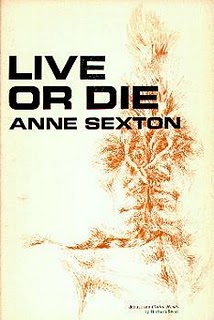
I am so happy that you felt inspired to write after reading the chapbook! What inspired me to write that chapbook? That is a hard question to answer. I think it came down, basically, to the title of Anne Sexton’s book Live or Die. There was a poem that never made it into my chapbook that began, “When the fear of death is equal to the fear of life, /O God, I walk through the rooms I have walked through/for ten years, and the rooms pretend they don’t know me.” I was writing those poems at a time in my life when I was secretly miserable. I tried hard not to show my husband or my friends—anyone—what was happening inside me, but I really didn’t know how I was managing to survive. There is a quote from The Cloud of Unknowing, a very old treatise by an anonymous monk on how to merge with God—for lack of a better way to express the unnameable—and the quote goes like this: “And yet in all this, never does [she] desire to not be, for this is the devil’s madness and blasphemy against God…. At the same time, however, [she] desires unceasingly to be freed from the knowing and feeling of [her] being.” That quote expresses another aspect of the longing to die; there is a longing for what some call “the death of the small self,” a longing not for the ultimate end of the body but for some experience of enlightenment. I had that in me, too, not enlightenment, but a desire for it, this small seed of hope that there could be something greater. I think that is why all the poems in Petals are addressed to an unknown “God.”

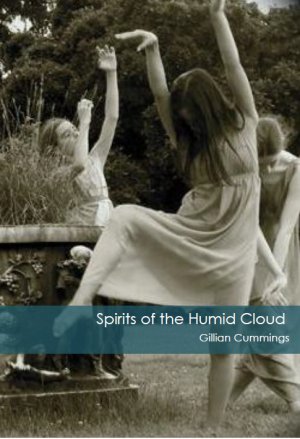
Anne Sexton is one of my favorite poets, one of the first poets who gave me access into poetry, perhaps because of her close attention to the gendered experience of being female. Your chapbook Spirits of the Humid Cloud published by Dancing Girl Press opens with an evocative epigraph on that luminous place between girlhood and womanhood, being a girl and being a woman, and suggests a third space. Talk about how gender informs your poetry.

When I first started to write poems, I never thought of them as being informed by gender. I just wrote what I wrote out of necessity, though I had read writers like Sexton and Plath at that time. Then, years ago now, I read Larissa Szporluk’s Dark Sky Question and I entered this very mysterious world she created that somehow managed to recreate trauma in a way that seemed markedly feminine and both vague and visceral at the same time. I consider her to be a huge influence on the work I have done recently. And I should mention, that though my chapbook Petals as an Offering in Darkness was published later than Spirits of the Humid Cloud, the writing that forms the chapbook Spirits was written after the prayer-poems of Petals and is much more characteristic of the recent work I’ve been doing. These days, often, I need to write using the pronoun “she.” There are some things too difficult for me to approach directly and claim as my own experience.


There are many women poets who have written about nature like May Swenson, Mary Oliver, Elizabeth Bradfield and many wonderful nature poems. Both of your chapbooks approach nature. What writers and literary sources enabled you to consider how a writer might make nature a troupe in poetry?

Oh, since very early on in my life, Keats’ “To Autumn” has been a favorite poem of mine. To me, it seems like a perfect poem and I often think, “If only I could write something that beautiful!” Very old-fashioned of me, right? But I am a little old-fashioned in some ways. And then there is Robert Hass: I love the way his poems manage to be so specific about landscape, how he will not say “bird” or “jay”—it has to be “Steller’s jay.” I think I sound so stupid saying this, because it is such an obvious characteristic of his work, but after reading him for the first time, I felt I must try to be as accurate as possible when naming plants and animals. Though I do love thinking of them as “Nature’s People,” as Dickinson calls them.


In the January/February 2014 issue of Poets & Writers, Celia Johnson examines the walking habits of Virginia Woolf, Charles Dickens, William Wordsworth and more in her essay “Pedestrian Adventures: Walking to Inspiration.” She argues that exercise promotes creativity as it lessens anxiety. Given your focus on nature and the careful descriptions of the natural world in your poetry, do you spend time in nature exercising? How does exercise tie into your creativity, inspiration, and general well being as a writer?

That is a question I can almost answer in two words: Rockefeller Park. I live in Westchester County, New York, basically in the suburbs. But my apartment is only fifteen minutes away from pure bliss, and by that bliss I mean the park. There are acres and acres of trails to follow—through woods, through meadows and farmland, around a lake, beside a river and its many streams—it seems endless. It’s very strange to me that often the people I encounter on my walks are foreigners who are sight-seeing or Americans who are there to walk their dogs. I can’t really understand running on a treadmill in a gym with four TV screens flashing images in front of you, when there exists this park and others like it. But as far as how it ties into writing: in the park, while walking, I often enter a kind of deep inner silence in which I am not separate from the landscape around me. After I come back from instances in which I experience this state of mind, I often hear words and rhythms forming, as I had mentioned before. These words seem like gifts from the park and they are. I don’t know where I’d be without my park pass!


What support have you received thus far that has enabled you to have two chapbooks published, an MFA, and publications in Cutbank, Quarterly West, The Cincinnati Review, and elsewhere? What kinds of support does a budding or mid-career writer need today?

Friends have been there for emotional support and for the mutual sharing of poetry. As far as having poems accepted in magazines, it has largely been luck—luck and perseverance, though once a kind man who was a reader for one publication took me under his wing for a while, because he liked a submission I sent. I owe him deep gratitude. What this means for other writers: I think it’s important to have 1) quiet time, quiet space, 2) the ability to build some community for yourself as a writer, whether this means an MFA program or poetry workshops at a local literary center or connections you discover through online networking, 3) belief in your own worth, as a writer, as a person, and 4) a love of reading.


How are you trying to get better as a poet? By reading the work of other poets and memorizing poems when I can.

Your chapbook credo: I’m not sure I have one.

Number of chapbooks you own:
 48 and counting

Number of chapbooks you’ve read: 47

Ways you promote and serve other chapbook poets:
 I have a favorite chapbook, Kathy Garlick’s The Listening World. Though it’s out of print and often hard to find, I search for copies to give to friends. I have also, recently, organized a reading for poets published by Finishing Line Press. I would like to organize more readings of this kind in the future.

Where you spend your chapbook earnings: My chapbook earnings are not so substantial. Were they substantial, I’d purchase chapbooks with them. Were they really substantial, I’d take a long trip to Norway in the summer and drive up the Western coast to see the fjords and the midnight sun.

Your chapbook wish: For more people to read chapbooks. For more people to write amazing chapbooks and have them published and for these chapbooks to somehow fall into my hands.

Residence: White Plains, New York

Job: Not currently working.

Chapbook education: I mentioned Kathy Garlick’s The Listening World. Louise Glück’s October and Jennifer Militello’s Anchor Chain, Open Sail have also been important chapbooks for me.

Chapbook Bio: Spirits of the Humid Cloud (dancing girl press, 2012) and Petals as an Offering in Darkness (Finishing Line Press, 2014). For a longer bio, please see my website http://www.gilliancummingspoet.com